
Sign up to save your podcasts
Or

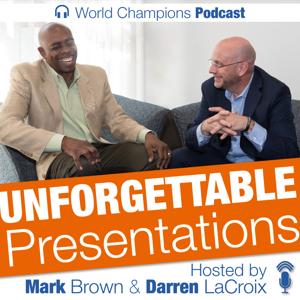


Change is constant and as presenters, we must stay relevant. Today Darren and Mark explore ways for us to stay current, stay relevant and become unforgettable.
SNIPPETS:
• Seek to serve your audience
• Update websites, slide decks, and demo videos regularly
• Stay aware of industry changes
• Be aware of what's 'top of mind' in your area of expertise
• Constantly look for relevant stories and events
• Look for the 'emotional juice.'
• Update your references, quotes, and content
• Get familiar with new and emerging technology
• Learn about current hot topics
• Explore new tools (TALKADOT etc.)
• Use your network and mastermind
• Use Google search 'NEWS' option for client organization updates
What does it take to truly become the speaker everyone loves and a master of your craft? Mark and Darren offer a 'mathematical formula' and a process to not only become a master, but to be unforgettable as well.
SNIPPETS:
• It starts with a decision to master your craft
• Commit to the work
• Put in the EFFORT
• Multiply EFFORT by a PROVEN PROCESS
• Use the CORE 4 PROCESS
• Learn how to make each step better
• Add a QUALIFIED COACH
• Tweak your technique
• Learn what your audience needs from you
• Master your craft and create your process
• Give your audience your process and help them grow
Emerging presenters often wonder, "Should I join the National Speakers Association? Toastmasters? Both?" Darren and Mark ask and answer these questions while sharing the benefits of both organizations.
SNIPPETS:
• Learn the art and business of speaking
• Both organizations are valuable
• Toastmasters is a wonderful place to make mistakes
• NSA provides business-building tools and expertise
• Toastmasters provides a friendly practice audience
• NSA helps build professional relationships
• Visit 3 Toastmasters clubs
• Attend an NSA meeting as a guest
• Find out how you can serve each organization
• Both provide mentorship
• Visit both NSA and Toastmasters for what you can get, and what you can give
Jeff Rogers, a fairly new member of the National Speakers Association, is the winner of NSA's LAST STORY STANDING storytelling competition. He and Mike Davis…one of his coaches…chat with Mark and Darren about his intent, his process, and the lessons he learned on his journey to the first-place trophy.
SNIPPETS:
• Seek to build relationships first
• Enter contests to learn
• Work with a coach to sharpen your story
• Step away from your ego
• Don't just tell the story; enact it
• Show your characters' perspective
• Don't be the hero of your own story
• Your story's hero can be a CONCEPT
• Stay in your style; don't let anyone coach you out of it
• Go down with YOUR message
• Practice, then go play
Rotary Speech Contest, Story SLAM, MOTH, Last Story Standing, World Championship of Public Speaking, and more. Speech competitions abound, and today Darren and Mark are joined by Stage Time University faculty member Mike Davis as they face the question: "Why compete?" Their answers provide the myriad benefits of competing.
SNIPPETS:
• Get better faster, grow, and improve quickly
• Breakthroughs come from experience, and experience comes from competing
• Transcend your comfort zone
• Get coaches - plural
• Competition pushes you to work harder
• Get a higher level of feedback
• Push to be your best at your competition's level of excellence
• Build confidence
• Learn lasting techniques from the best
• Apply discipline and a process
• Work against a clock with deadlines
Imagine being asked to deliver new material, on a subject you have never addressed, on short notice, under pressure, three times in 24 hours. Today, Mark and Darren talk with professional speaker and coach Sheree Cain-Jones, who found herself in that situation recently. Her insight from the lessons learned, and the principles she applied along the way, will help you navigate the 'new content on short notice' path, and deliver your unforgettable presentation.
SNIPPETS:
• Acknowledge the weight of responsibility when delivering new content
• Stop, think, take it in, then decide to accept an assignment on short notice
• We can find reasons to say 'no;' find reasons to say 'yes'
• Be wary of your 'echo chamber' and lean on your support group
• Start with a PREGNANT PREMISE
• Adopt a research mindset and dig deep into your topic
• Put on your hat of humility
• Be vulnerable, even though it creates risk
• To internalize content, record, listen, re-record, listen again
• Don't be perfect; be prepared
• Incorporate your strengths and skillset
• Your message isn't in you; it IS you
We ALL speak with an accent, and at times it's easy to believe that we must 'lose' our accent to be accepted. Today, Mark and Darren have a frank conversation with speech and accent expert Dr. Leslie Gordon, as she gives advice on using your accent as an asset.
SNIPPETS:
• Honor the skill of owning more than one sound
• Treat the world as a playground for your eyes and ears
• The way we speak creates a picture of who we are
• Your accent is a tool in your toolkit
• Your accent can create a connection
• Your accent is a layer of your story
• We all have more than one accent
• Focus on being understood and prioritize clarity
• Language can be a social and political tool, causing some to feel 'othered'
• Move away from self-judgment
• Code-Switching requires great skill and is governed by rules
• Don't think 'accent reduction;' think 'accent acquisition'
• Your accent can feel like home
Script writing takes work and the practical, time-saving methods that Darren and Mark discuss today will make the process easier. Listen as they examine how to create your first script, edit with impact, and use your script as a presentation roadmap.
SNIPPETS:
• You can't edit what you don't create
• In Microsoft Word use DICTATE to generate a transcript
• Create your 'sloppy first copy'
• Separate each line of your script
• Add LINE NUMBERS in Google Docs, MS Word, etc.
• Add WORD COUNT
• Insert PAGE NUMBERS
• Insert LINE NUMBERS
• Customize with pause cues, timing cues, emotion cues, and stage direction
• Color code notes as you wish
• Say it better with fewer words
Quotations from famous speakers, authors, and celebrities can be very appealing and can support your message. The same can be said of oft-quoted statistics. Today Mark and Darren discuss the importance of accuracy when using quotes and statistics, share a few examples, and provide simple yet effective advice for 'getting it right.'
SNIPPETS:
• Do due diligence
• Your reputation and credibility are at stake
• Verification sources abound…web searches, AI, etc. Use them
• "Stop quoting dead white men!" – Patricia Fripp
• Create your own quotes
• Quote the people who have influenced you…teachers, friends, family
• Your audience needs your perspective
• Verify EVERY quotation for accuracy
• Double check the context of every quote and statistic
• Name the source of each quote and statistic
• Your accuracy…and inaccuracy has a global reach
Sometimes, even after your best pitch, the answer is "No." But that need not be the end of the relationship. Darren and Mark offer some sage wisdom about taking advantage of every 'no,' and sometimes turning a "no" into "yes."
SNIPPETS:
• No can mean several things
• "Not yet, not the right time, not the best fit"
• Be remembered
• Have CONTENT and INTENT
• Don't take "no" personally
• Build relationships, regardless of the outcome
• Play the long game
• Record and replay each sales call to learn from every "no"
• Be a referral resource when you get a "no"
• Be a favorite
From the publisher's feed

43,356 Listeners
2,266 Listeners

152,832 Listeners

2,697 Listeners

4,585 Listeners

1,936 Listeners
13,975 Listeners
97 Listeners

27,962 Listeners

640 Listeners

815 Listeners

2,215 Listeners

29,171 Listeners

26,561 Listeners

19,071 Listeners