
Sign up to save your podcasts
Or




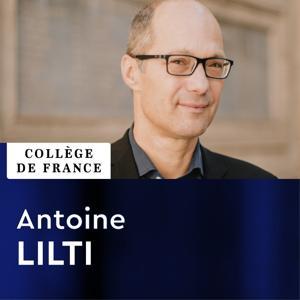
Antoine Lilti
Collège de France
Histoire des Lumières, XVIIIe-XXIe siècle
Année 2023-2024
Colloque - Lumières Médiatiques : Jean-Marie Chassaignon et les affres du devenir-media
Session 5 – Les imaginaires médiatiques
Colloque organisé par Antoine Lilti, Professeur du Collège de France
Avec le soutien de la Fondation Hugot et de l'Institut historique allemand.
Yves Citton, Université Paris 8
Antoine Lilti
Collège de France
Histoire des Lumières, XVIIIe-XXIe siècle
Année 2023-2024
Colloque - Lumières Médiatiques : La réputation des anonymes. Presse d'annonce, contrôle social et espace médiatique
Session 4 – La fabrique des réputations
Colloque organisé par Antoine Lilti, Professeur du Collège de France
Avec le soutien de la Fondation Hugot et de l'Institut historique allemand.
Ulrike Krampl, Université de Tours
Antoine Lilti
Collège de France
Histoire des Lumières, XVIIIe-XXIe siècle
Année 2023-2024
Colloque - Lumières Médiatiques : Race, révolution et célébrité dans le monde atlantique. Le cas du chevalier de Saint-George
Session 4 – La fabrique des réputations
Colloque organisé par Antoine Lilti, Professeur du Collège de France
Avec le soutien de la Fondation Hugot et de l'Institut historique allemand.
Christy L. Pichichero, George Mason University
Antoine Lilti
Collège de France
Histoire des Lumières, XVIIIe-XXIe siècle
Année 2023-2024
Colloque - Lumières Médiatiques : Faire et défaire l'autorité médicale. La sphère publique de la santé
Session 4 – La fabrique des réputations
Colloque organisé par Antoine Lilti, Professeur du Collège de France
Avec le soutien de la Fondation Hugot et de l'Institut historique allemand.
Meghan Roberts, Bowdoin College
Luigi Rizzi
Linguistique générale
Collège de France
Année 2023-2024
Colloque - Syntactic Cartography and African Languages : The View from CiCewa (Bantu): Towards a Cartography of Passive Voice(s) and Developing Terraling
Colloque organisé par Luigi Rizzi, Professeur du Collège de France, chaire linguistique générale
Avec le soutien de la Fondation du Collège de France.
Hilda Koopman, UCLA
In this talk, I will establish a cartography of Passive (and passive-like) Voice(s) for Chichewa (Bantu), use it to explore the observed crosslinguistic variation in passive constructions across languages, and implement the findings in a (pilot) comparative Terraling dataset for passive constructions that can serve as the basis for further current or future theoretical investigations.
Like many Bantu languages, Chichewa has extensive verbal morphology, with both a postverbal applicative morpheme and two passive(-like) morphemes (Alsina & Mchombo (1990) [1], Alsina (1999) [2], Dubinsky & Simango (1996) [3]). The applicative morpheme -ir adds a variety of arguments/adjuncts to the verbal stem, not only goals or benefactives, but also instruments, or locative adjuncts. The stative morpheme (-ik) occurs in middles and potentials. The passive morpheme -idw occurs not only with canonical (agent-theme) and low oblique applicative passives, but also with non-canonical passive applicative constructions (instrumental, locative, ...). Applicative and statives/passive can co-ocur in different orders V-stat-Appl, but V-Appl-Pass, or V Pass Appl the latter restricted to Instrumental and locative applicatives.
Various interactions determine the cartography of Passive-(like) Voice(s) in Chichewa. Passive Voice(s) and Applicative interact with the argument structure ("little" vP) and the hierarchy of "obliques"/ PPs/applicatives (Schweikert (2005) [4]; morpheme orders reflect the syntactic derivation and give insight into the order of operations; stative and passives occur in different regions in Cinque's functional hierarchy (Cinque (1999) [5]) etc. Taken together, this leads to a general cartography of Passive Voice(s), and the conclusion that not only stative, but also passive voice(s) in Chichewa can be merged at different heights in the hierarchical structure. Because Passive can be merged above Locative, Locative can be passivized. Because Passive can be merged below APPL, passive voice can be merged below Instrumental and Locative, and only themes can be passivized in this order. This investigation provides important insights into some fundamental theoretical questions. What is the element that introduces the external argument a (light)verb: little v? ("yes") or (Kratzerian) Voice ("no"), and where is it located (above locative adjuncts or below) ("both are attested")? What are the formal properties of Passive Voice: is (Passive) Voice ever involved in argument structure (assigning or reducing argument structure?). Or is it simply a vehicle, devoid of any semantic properties, that serves to map arguments on their syntactic positions ? We briefly explore how variation in height of Merge further leads to a new typology of passive-like constructions crosslinguistically, and show how to concretely implement the findings in the open crosslinguistic Terraling-dataset for passive-like constructions https://terraling.com/groups/13.
Références
[1] Alsina, Alex & Sam Mchombo. 1990. The syntax of applicatives in Chichewa: problems for a theta theoretic asymmetry. Natural Language and Linguistic Theory 8(4). 493–506.
[2] Alsina, Alex. 1999. Where's the Mirror Principle? The Linguistic Review 16(1). 1–42.
[3] Dubinsky, Stanley & Silvester Ron Simango. 1996. Passive and Stative in Chichewa: Evidence for Modular Distinctions in Grammar. Language 72(4). 749–793.
[4] Schweikert, Walter. 2005. The order of prepositional phrases in the structure of the clause, vol. 83. John Benjamins Publishing.
[5] Cinque, Guglielmo. 1999. Adverbs and functional heads: a cross-linguistic perspective. New York: Oxford University Press.
Luigi Rizzi
Linguistique générale
Collège de France
Année 2023-2024
Colloque - Syntactic Cartography and African Languages : Clause Structure and Word Order Variation in Gude (Chadic)
Colloque organisé par Luigi Rizzi, Professeur du Collège de France, chaire linguistique générale
Avec le soutien de la Fondation du Collège de France.
Edmond Biloa, Université de Yaoundé 1, Cameroun
This work analyses the structure of the left periphery in focalized constructions, interrogatives, relatives and topicalized structures in Gude, a Chadic language of Cameroon. Constituent movements are attested in this language, the basic word order of which seems to be VSO (Verb-Subject-Object). Syntactic Cartography is deemed capable of accounting for this empirical material variation. The word order attested in this language is derived via verb movement. Moreover, focalization triggers verb movement. The structure of topic constructions and the topic-focus distribution are discussed. Finally, what can the Gude data tell us about the structure of the left periphery with respect to ForceP and IntP?
Luigi Rizzi
Linguistique générale
Collège de France
Année 2023-2024
Colloque - Syntactic Cartography and African Languages : Focus Marking and Interpretation in Mabia Languages
Colloque organisé par Luigi Rizzi, Professeur du Collège de France, chaire linguistique générale
Avec le soutien de la Fondation du Collège de France.
Daniel Aremu, Goethe-Universität, Frankfurt
Luigi Rizzi
Linguistique générale
Collège de France
Année 2023-2024
Colloque - Syntactic Cartography and African Languages : Evidence for Low Information Structure – The Case of West-African Languages
Colloque organisé par Luigi Rizzi, Professeur du Collège de France, chaire linguistique générale
Avec le soutien de la Fondation du Collège de France.
Katharina Hartmann, Goethe-Universität, Frankfurt
Johannes Mursell, Goethe-Universität, Frankfurt
Following the seminal work of Rizzi (1997), the left periphery of the clause has received a considerable amount of attention with respect to information-structural marking. It turns out that the marking of categories like topic and focus is not only restricted to fronting the respective elements to the specifiers of dedicated functional projections, but many languages provide further evidence for the existence of these structures, for example by overtly realizing heads of these projections.
Taking this proposal a step further, Belletti (2004) argues for a low focus projection in Italian. Her proposal predicts the existence of overtly realized heads of the low focus phrase, in parallel to the high focus projection. However, neither Italian nor other well-investigated languages show such overt realizations.
In this talk, we discuss this hypothesis, based on evidence from various West-African languages. Starting with Chadic languages, spoken in Northern Nigeria and neighboring countries, we will argue for a clear ex-situ/in-situ asymmetry in focus marking, with the in-situ options being compatible with the assumption of a low focus projection. Turning to Mabia languages, a language family spoken in Northern Ghana and surrounding countries, a similar in-situ/ex-situ asymmetry is pervasive in these languages. In addition, and crucial to Belletti's hypothesis, in-situ focus is obligatorily marked by an in-situ focus marker.
We will discuss these low focus marker in some detail, as it turns out that this marker expresses the low focus head only in a subset of languages, whereas in others, it needs to be analysed as being adjoined to locally focussed constituents.
Luigi Rizzi
Linguistique générale
Collège de France
Année 2023-2024
Colloque - Syntactic Cartography and African Languages : How Language Contact Accounts for Mixed Typologies
Colloque organisé par Luigi Rizzi, Professeur du Collège de France, chaire linguistique générale
Avec le soutien de la Fondation du Collège de France.
Salikoko S. Mufwene, Université de Chicago, professeur invité du Collège de France
Few languages exhibit uniform patterns regarding the position of (suconstituents, hence the ensuing syntactic configurations, for example, the position of the verb relative to its arguments, the position of various determiners, and the position of modifiers of nouns. Based on what has been learned from the emergence of creoles' structures, one must wonder whether this is not the case also in their lexifiers, which are themselves also outcomes of language contact. What has traditionally been characterized as simplification of the morphosyntax in creoles amounts to mere typological realignment in contact situations where selection from among competing variants is driven by various language-ecological factors. I will adduce examples from English, French, Bantu and related "creoles" to illustrate my hypothesis.
Luigi Rizzi
Linguistique générale
Collège de France
Année 2023-2024
Colloque - Syntactic Cartography and African Languages : Focus Movement in the Low Focus Field in Grassfields Bantu
Colloque organisé par Luigi Rizzi, Professeur du Collège de France, chaire linguistique générale
Avec le soutien de la Fondation du Collège de France.
Paul Roger Bassong, Ingénieur-chercheur, chaire Linguistique générale du Collège de France
Gratiana Linyor Ndamsah, Université de Yaoundé 1, Cameroun
From the publisher's feed
Colloques interdisciplinaires du Collège de France
Événements de la vie scientifique de l'établissement, les colloques, dont le programme comprend à la fois des professeurs du Collège…
209 Listeners

2,448 Listeners

13 Listeners
22 Listeners

104 Listeners
0 Listeners
1 Listeners
5 Listeners
0 Listeners
0 Listeners
1 Listeners
227 Listeners

114 Listeners
66 Listeners
110 Listeners
62 Listeners
75 Listeners

24 Listeners
0 Listeners
0 Listeners

34 Listeners
19 Listeners
0 Listeners
0 Listeners
1 Listeners
0 Listeners
3 Listeners

0 Listeners

0 Listeners
0 Listeners
0 Listeners
0 Listeners
0 Listeners
0 Listeners

0 Listeners