
Sign up to save your podcasts
Or

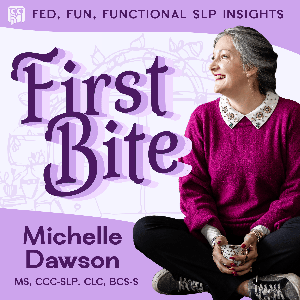


Guest: Marina Shipilova, MS, CCC-SLP - In this course, the presenter discusses her successful strategies for connecting with families from different cultures, the most common empowering advice she gives to families, and how to hold crucial conversations to embolden caregivers when barriers exist to accessing the highest quality services available to them. Michelle and Marina share some of their more memorable moments from the field (the flops and successes) to inspire us all to embrace the joy and evidence of caregiver coaching.
Guest: Raquel Garcia, SLPD, CCC-SLP, CNT, BCS-S - In this course, the presenter discusses hypoxic-ischemic encephalopathy (HIE) and how this devastating diagnosis can result in pediatric dysphagia. We learn about new resources and organizations, such as “Hope for HIE”, that are educating and advocating interprofessional practice partners and caregivers about the most current research to advance the quality of care for even our littlest patients.
Guest: Jennifer Casteix, MS, CCC-SLP - In this episode, discuss how to mentor the next generation of pediatric feeding disorder clinicians. Do you have a waitlist a mile-long for your services? Do you have a calling to do “more” for our profession, but are unsure of where to begin? Do you have a bit of wit along with your PFD wisdom and a desire to share it? Then join Jennifer as she inspires us to take up the mantle of Clinical Supervision and Mentorship! Learn an update on the current state of affairs of pediatric feeding disorder coursework in graduate school to understand the knowledge base students are coming to us with, and then embrace the conversation regarding different adult learning styles as strategies to effortlessly train our profession’s future.
In this episode, Michelle and Erin will focus on clarifying the differences between “playful” and “play-based” language therapy and how this approach can make your therapy more functional and fun! The power of “play” is one of the most powerful tools in our toolboxes even recognized and recommended by the American Academy of Pediatrics. But, how do we embrace this approach effectively and overcome the barriers in our sessions? Erin and Michelle will clarify misconceptions and inspire listeners with an “easy-peasy-lemon-squeezy” evidence-based plan to assist in their next therapy sessions.
Guests: Kylie Jeffrey, MS, OTR/L & Serena Murison, MS, CCC-SLP - This episode is an hour dedicated to understanding what neurodiversity-affirming intervention is. The guests explore some evidence-based sources of information regarding this fundamental shift in clinical service delivery, and most importantly functional strategies to effectively implement this approach.
Guest: Jessie L. Ginsburg, M.S., CCC-SLP - Jessie joins the ladies of First Bite and explores what sensory integration is and why speech-language pathologists need to understand its impact. They will also discuss the speech-language pathologists’ role in implementing sensory strategies as well as describe two strategies for improving regulation during pediatric speech therapy sessions.
Michelle and Erin discuss how a little one’s diagnosis of cerebral palsy (CP) can impact functional communication and potentially result in a pediatric feeding disorder (PFD). It is important for a clinician to understand how the four major groups of CP differentiate from one another because each presentation comes with its own treatment considerations given unique comorbidities. Join Michelle and Erin as they deep dive into how the four classifications of CP can impact access to functional communication and feeding.
Guest: Ed Bice, MEd., CCC-SLP - Have you ever taken a course and thought, “Wow! Yes! This is what my patients need!” and then felt a little embarrassed at how you were previously treating their dysphagia deficits? Why do we have those dysphagia competency concerns, to begin with? If you have ever asked the “why,” then join Michelle and Ed as they explore the limitations in professional preparedness. Ed walks us through how limitations in academic coursework (even down to textbook selection) impact professional preparedness for clinical competency but then offers functional solutions to remedy the situation.
Guest: Rachel Hahn Arkenberg, MS, CCC-SLP, CLC - In this course, the guest shares a dynamic systems approach to studying the neurophysiological development of swallowing in the context of family, culture, language, and motor development. Rachel explains the barriers to obtaining high-quality evidence for treatment of pediatric feeding disorder (PFD), challenges us to critically assess the evidence that is available, and then explains how research from allied health fields can be effective in treatment.
Guests: Cara Smithwick, MLIS, BS, and Mary Reaves, MRC - The guests discuss all things collaboration for advocacy and education with deaf/hard of hearing children and their caregivers. Cara and Mary, who founded Beginnings SC as a labor of love for improved education and empowerment of parents/caregivers of deaf/hard of hearing children, start the hour outlining the steps taken to create a life-changing non-profit organization. If you have ever wondered how to improve your role as the SLP on the team for a deaf/hard of hearing child, then join Cara and Mary as they inspire us all with the functional support systems/strategies used for the thousands of lives they serve and impact and most importantly what steps we can take to improve our interprofessional practice for these little ones.
From the publisher's feed

171,968 Listeners

12,075 Listeners
6,450 Listeners

8,306 Listeners

221 Listeners
164,465 Listeners
47 Listeners

6,233 Listeners
13,925 Listeners
124 Listeners

27 Listeners
7,542 Listeners
427 Listeners

15,409 Listeners

29,138 Listeners
6 Listeners

3,700 Listeners
12 Listeners
3 Listeners

9 Listeners
7 Listeners
7 Listeners