
Sign up to save your podcasts
Or



Guests: Maggie Wheeler, MS, CCC-SLP, and Briana Klar, MS, CCC-SLP
Earn 0.10 ASHA CEUs for this episode with Speech Therapy PD: https://www.speechtherapypd.com/courses/pfd-and-ut
Imagine a world where every SLP receives hands-on training in pediatric feeding and swallowing disorders as part of their university practicum experience! How incredible would it be to build a foundation in patient care alongside early literacy and speech-sound strategies?
Thanks to Maggie Wheeler, MS, CCC-SLP, and Briana Klar, MS, CCC-SLP, at the University of Tennessee Health Science Center, that vision is becoming a reality. These inspiring educators are integrating interprofessional education for the evaluation and treatment of PFD into their graduate program while providing exceptional care to little ones in their community.
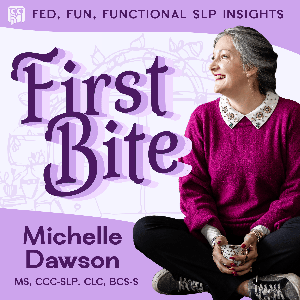
In this First Bite episode, Michelle Dawson, MS, CCC-SLP, CLC, BCS-S, sits down with Maggie and Briana to learn how they brought this vision to life and to share ideas for creating similar opportunities at your university.
Show Notes:
University of Tennessee Foundation: https://utfi.org/giving/
About the Guests: Maggie Wheeler, MS, CCC-SLP, has been with the University of Tennessee Health Science Center since 2018, serving in the Pediatric Language Clinic and, more recently, the UT Hearing and Speech Center, working as a clinical assistant professor. She has expertise in parent training, early intervention, autism, and early language. Ms. Wheeler also treats early intervention patients with pediatric feeding and augmentative communication needs. Her previous experience in public schools has made her passionate about helping parents smoothly transition from early intervention into the public school system. She also strives to support her family by connecting them with local resources to support the needs of their child.
Briana Klar, MS, CCC-SLP, is a clinical instructor at the UT Hearing and Speech Center with a focus on pediatric feeding and swallowing disorders. Her clinical experience spans private practice, schools, and pediatric outpatient. Briana is passionate about using a responsive feeding approach to create positive, family-centered feeding environments that support both children and their caregivers in overcoming feeding difficulties. In addition to her work in pediatric feeding, Briana also has a strong interest in augmentative and alternative communication (AAC) and enjoys helping children with complex communication needs.
Guest: Rachel Conrad, MA, CCC-SLP
Earn 0.10 ASHA CEU for this episode with Speech Therapy PD: https://www.speechtherapypd.com/courses/embracing-lived-experiences
In the first episode of 2025, Michelle is joined by Jaclyn Pederson, MHI, CEO of Feeding Matters, and William Sharp, PhD, Director of Children’s Multidisciplinary Feeding Program (Atlanta, GA) and Professor at Emory University School of Medicine, to lay the foundation for a year of combining passion, advocacy, and learning. These guests share their expertise and highlights from a recent journal publication on how the diagnoses of “Pediatric Feeding Disorder” and “Avoidant Restrictive Feeding Intake Disorder” are individualistic while simultaneously overlapping to capture the unique needs of the little ones on our caseloads. Additionally, they share practical insight into the roles and responsibilities of various team members, such as the SLP and the psychologist, in evaluating and treating these little ones as part of an interprofessional practice team.
About the Guest:
Rachel Conrad, MA, CCC-SLP, is the owner of Bite and Bloom Therapy, LLC, under The Mindful Collective, where she specializes in pediatric feeding and swallowing, ARFID, AAC, and sensory-based therapy. She serves as the Chair of the Feeding Matters Research Consortium, a patient- and family-centered research initiative partially funded by the Patient-Centered Outcomes Research Institute (PCORI). Rachel brings a unique perspective to her work, combining her professional expertise with her lived experience of pediatric feeding differences and ARFID. She collaborates with The Village, a perinatal and eating disorder provider group, and participates in national advocacy and education initiatives to improve early intervention and interdisciplinary care for children with feeding differences. Rachel has delivered presentations and talks on best practices for evaluating and treating medically complex children with feeding and swallowing disorders. She is passionate about creating spaces where patients and families feel truly heard, seen, and valued in discussions about feeding differences. She is a member of the American Speech-Language-Hearing Association (ASHA) and the Kansas Speech-Language-Hearing Association (KSHA) and is committed to advancing awareness, research, and best practices in pediatric feeding and swallowing. Rachel bridges the gap between research, clinical practice, and lived experience to support children and families navigating feeding differences.
Show Notes:
Bite & Bloom Therapy: https://www.mindfulcollectivegroup.com/rachel-conrad
Feeding Matters: https://www.feedingmatters.org
Find Assistance: https://www.findhelp.org
Guest: Kathryn (Kati) C. R. Knudsen, PT, MPT, CNT, PCS, DCS, CLE
Earn 0.1 ASHA CEU for this episode with Speech Therapy PD: https://www.speechtherapypd.com/courses/pts-and-feeding-in-the-nicu
Did you know Physical Therapists can play a vital role in feeding and PO readiness in the NICU? They sure can! If you’re curious about the unique expertise they bring to the table, this episode is for you.
Join Michelle Dawson, MS, CCC-SLP, CLC, BCS-S, as she chats with Kathryn C. R. Knudsen, PT, MPT, CNT, PCS, DCS, CLE—affectionately known as “Kati”—a NICU PT with more than 25 years of experience. Kati shares her journey into neonatal care, explores the specialized training PTs receive to support oral readiness, and offers insight into how they help caregivers who are learning to chest feed or bottle feed their little ones.
You’ll also hear about the effects of Neonatal Opioid Withdrawal Syndrome (NOWS) on feeding development and how collaborative care between SLPs and PTs can make a real difference. This episode is a powerful example of interprofessional teamwork, with the shared goal of helping babies and caregivers thrive.
Show Notes:
Find Local Assistance: https://www.findhelp.org
"Welcome to Holland" Poem: https://www.emilyperlkingsley.com/welcome-to-holland
About the Guest: Kati Knudsen has practiced as a pediatric physical therapist since 1996 and as a therapist in the NICU since 1999. Kati served as lead therapist for two NICUs at sister hospitals in Portland, Oregon for 10 years, and continues to work per diem for these hospitals while serving as an account manager for Dr. Brown’s Medical. She has obtained certifications in neonatal therapy, pediatric physical therapy, lactation education, neurodevelopmental treatment, infant massage, developmental care, and transportation of children with special needs to better support infants and families. Kati has published articles about support for preterm and medically fragile infants and spoken nationally and internationally on improving the care of infants in the NICU. Kati serves as the therapy representative on the Vermont Oxford Network Multidisciplinary Advisory Council and is a founding member, past co-chair, and past treasurer of the Neonatal Therapy Certification Board. Kati saw patients in NICU follow-up clinic for more than 25 years where she also helped to redesign care to make it more accessible to families. Kati’s overall goal with her professional activities is to support improved long-term outcomes for medically fragile infants and their families.
Follow First Bite: https://linktr.ee/FirstBitePodcast?utm_source=linktree_profile_share<sid=1571047e-c5cf-4d4a-8cc6-08ec5871aeb5
Spotify: https://open.spotify.com/show/36kfA1xbU156vHPilALVoJ?si=c187e347d3984b45
Apple Podcasts: https://podcasts.apple.com/us/podcast/first-bite/id1399630680
Guests: Chelsie Esek-Onyeahialam, MS, CCC-SLP, and Jordyn R. Montique, MS, CCC-SLP
Earn 0.1 ASHA CEU for this episode with Speech Therapy PD: https://www.speechtherapypd.com/cours...
If you’re an advocate for creating inclusive spaces, an ally for growing diversity within our profession, and want to engage in professional networking through evidence-based empowerment, then y’all, this is the hour for you!
Chelsie and Jordyn educate colleagues on “White Supremacy Culture” and how it manifests in the field of speech therapy, discuss common barriers BIPOC individuals encounter when entering the profession, and inspire us all with strategies our field can take to overcome them.
Show Notes:
#BlackSLPMagic: https://www.blackslpmagic.org
#BlackSLPMagic Linktree: https://linktr.ee/blackslpmagic
JRC the SLP: https://beacons.ai/jrc_theslp
Esek Health: https://linktr.ee/EsekHealth
Culturally Responsive Clinician Handbook: https://www.raynetherapy.com/thecultu...
About the Guests:
Chelsie Esek-Onyeahialam, MS, CCC-SLP is a highly respected, board-certified Speech-Language Pathologist whose career reflects both academic excellence and an unwavering dedication to healthcare equity. A proud Magna Cum Laude graduate of Howard University with a Master of Science in Communication Sciences and Disorders, Chelsie has devoted her expertise primarily to acute care, where she champions improved access, outcomes, and advocacy for underserved communities.
Jordyn R. Montique, M.S., CCC-SLP is a speech-language pathologist and the owner of RAYNE Therapy, a private practice providing therapy for clients, school contracting, and professional development hours (PDHs). She is the author of The Culturally Responsive Clinician Handbook and the creator of JRCtheSLP, LLC, where she speaks, consults, and develops diverse therapy materials.
In this episode of First Bite, Michelle Dawson, MS, CCC-SLP, CLC, BCS-S, is joined by Dr. Amy Talbot, Director and Clinical Psychologist of the Talbot Centre in Australia, to unpack the well-established overlap between Pediatric Feeding Disorder (PFD) and Avoidant Restrictive Food Intake Disorder (ARFID). For SLPs new to this area of practice, the lines between roles and responsibilities, particularly with respect to each diagnosis, can be blurry, and Dr. Talbot is here to clean it all up!
If you are curious as to what the differences are between PFD and ARFID and want to learn more about how a psychologist can contribute to the care of clients with feeding-related concerns (PFD/ARFID) as part of a multidisciplinary team, then be sure to join this conversation.
By the end of the hour, Amy plans to equip guests with strategies for building relationships with suitably trained or qualified psychologists as part of their referral network, aiming to grow a robust interprofessional practice team.
Show Notes:
Feeding Matters: https://www.feedingmatters.org
Talbot Centre: https://thetalbotcentre.com.au
Butterfly Foundation: https://butterfly.org.au
About the Guest(s): Dr Amy Talbot (she/her) is a multi-award-winning clinical psychologist and director of The Talbot Centre, a multidisciplinary service in Sydney. Her work focuses on eating, feeding, and body image concerns, with an emphasis on neurodiversity-affirming, family-centred care. Amy is a sought-after presenter, supervisor, and researcher, known for advancing interdisciplinary approaches to complex case formulation and integrating lived experience perspectives to improve outcomes for individuals with ARFID and related feeding disorders.
Follow First Bite: https://linktr.ee/FirstBitePodcast
Spotify: https://open.spotify.com/show/36kfA1xbU156vHPilALVoJ?si=086bed1210af45d5
Apple Podcasts: https://podcasts.apple.com/us/podcast/first-bite/id1399630680
In this episode of First Bite, host Michelle Dawson, MS, CCC-SLP, CLC, BCS-S, wraps up October’s AAC Awareness Month with one of her favorite guests, Stephen Kneece, MS, CCC-SLP! Stephen, founder of Speech and Language Songs on Instagram, is an AAC guru with Forbes AAC, a seasoned school-based SLP, and former Department Chair of Speech-Language Pathology at Columbia College. Did we mention he’s also a vocalist and guitarist too?!?
Tune in (pun intended) as Stephen guides us through the clinical decision-making process for AAC selection for the little ones on our caseloads, provides easy step-by-step directions for the evaluation-to-funding process, and shares alternative funding options when insurance denies.
If you’re new to AAC or to Forbes AAC, this episode will be sure to answer questions you didn’t even know you had!
Earn 0.1 ASHA CEU for this episode with Speech Therapy PD: https://www.speechtherapypd.com/courses/strategies-for-starting-aac
About the Guest: Stephen Kneece, MS CCC-SLP, is an experienced Speech-Language Pathologist with a deep-rooted passion for enhancing communication through technology. With a background that began in media arts and music, Stephen’s journey led him to discover his true calling in speech-language pathology. He earned his Bachelor of Arts in Media Arts with a minor in Music from the University of South Carolina and went on to obtain his Master of Arts in Speech Pathology and Audiology from South Carolina State University. Stephen’s professional path took shape during his nine years as a pediatric Speech-Language Pathologist in South Carolina’s public schools. It was here that he discovered his passion for working with Augmentative and Alternative Communication, finding immense fulfillment in helping children with complex communication needs express themselves. This experience sparked his dedication to AAC, laying the foundation for his future endeavors in the field. Before assuming his current role, Stephen served as Chair of the Speech-Language Pathology Program at Columbia College. He also served as a Lecturer and Clinical Supervisor. During his time there, he taught courses such as Phonetics, Language Acquisition & Development, Language Disorders, Speech-Language Pathology Clinical Technology, and Augmentative and Alternative Communication, while also guiding and mentoring students through their clinical practicums. In addition, Stephen spent four years teaching the Augmentative and Alternative Communication course at the University of South Carolina. His dedication to teaching and mentorship has left a lasting impact on the next generation of SLP professionals. In addition to his work in academia, Stephen’s innovative approach to therapy includes the creation of Speech and Language Songs, a platform that merges his love for music with speech therapy. His contributions to the field have been recognized both locally and nationally, including receiving the Louis M. DiCarlo Award for Outstanding Clinical Achievement in 2024.
Follow First Bite:
Spotify: https://open.spotify.com/show/36kfA1xbU156vHPilALVoJ?si=0be088bb08894091
Apple Podcasts: https://podcasts.apple.com/us/podcast/first-bite/id1399630680
Full conversation with Melissa Davis, MS, CCC-SLP and Jenna Nassar, MS, CCC-SLP, BCS-S, for "Intraprofessional Practice: Strategies for Effective Collaboration Between SLPs" an episode of the First Bite podcast.
Hosted by: Michelle Dawson MS, CCC-SLP, CLC, BCS-S
Earn 0.1 ASHA CEU for this episode with Speech Therapy PD: https://www.speechtherapypd.com/courses/intraprofessional-practice-strategies
In this episode of First Bite, we’re exploring what effective intraprofessional practice really looks like for SLPs in pediatrics. When colleagues collaborate well, everyone benefits—especially the little ones we serve.
Join Michelle Dawson, MS, CCC-SLP, CLC, BCS-S, as she interviews Melissa Davis, MS, CCC-SLP, owner of Speech Therapy for Kids and co-owner of Kids Therapy Spot in Starkville and Columbus, MS, and Jenna Nassar, MS, CCC-SLP, BCS-S, clinician and instructor in the Department of Otolaryngology–Head and Neck Surgery at the University of Mississippi Medical Center. Together, they share how they make intraprofessional collaboration work for optimal continuity of care.
Tune in to learn what a typical day looks like for a pediatric medical SLP in different settings, discover strategies to strengthen your clinical skills across those settings, and gain practical ideas for communicating effectively—even across hundreds of miles—so that the little ones on both your caseloads thrive.
About the Guest(s): Melissa Davis, MS CCC-SLP, is the owner of Speech Therapy for Kids and co-owner of Kids Therapy Spot located in Starkville and Columbus, MS. Melissa received her bachelor’s degree in Speech-Language Pathology from Middle Tennessee State University in May of 2000 and her master’s degree in Speech-Language Pathology from Mississippi University for Women in May of 2002. Melissa worked for two rehabilitation companies from 2002 to 2009, providing speech therapy services in homes and daycare centers for children in the early intervention program. In January 2010, Melissa went into private practice. She now has two outpatient clinics in Starkville and Columbus, MS, in addition to contracting speech therapy services at three Prescribed Pediatric Extended Care Facilities and the private schools in Starkville, MS. In addition to owning a private practice, Melissa continues to be a treating SLP primarily focusing on treating children with pediatric feeding disorders at her two outpatient clinics, in addition to the PPEC in Starkville, MS. She also consults on patients with PFD at the PPECs located in Meridian and Columbus, MS. Melissa is an active volunteer with Feeding Matters and was on the 2023 and 2024 ASHA PFD topic committee. She consistently speaks to undergraduate and graduate students at various universities about PFD and has also had numerous speaking engagements, presenting information on opening and operating a private practice.
Jenna Nassar, MS CCC-SLP, BCS-S, is a pediatric speech pathologist and an instructor in the Department of Otolaryngology-Head and Neck Cancer at the University of Mississippi Medical Center. In addition to these roles, she also serves as the pediatric outpatient team leader, clinical Internship coordinator for the Department of Speech Pathology, and as a member of the cleft and craniofacial team. She specializes in pediatric swallowing and feeding disorders and serves patients both inpatient and outpatient at Batson Children's Hospital. She holds Board Certification in swallow and swallowing disorders through the ABSSD. She is trained in a variety of treatment approaches for feeding and swallowing disorders. She is a member of the American Speech-Language-Hearing Association, the Mississippi Speech-Language-Hearing Association, SIG 13, and Feeding Matters. She was awarded the 2023 Clinical Achievement Award from the Mississippi Speech-Language-Hearing Association and the Association's Honors in 2025. In 20024, she served on the Pediatric Feeding Disorders Topic Committee for the ASHA Convention. She graduated summa cum laude in 2007 from the University of Mississippi for Women with a B.S. in speech and hearing science. She then graduated in 2009 with high distinction, earning an M.S. in Communicative Sciences from Jackson State University. She has served both the adult population and pediatrics, with a special interest in craniofacial development, tracheostomy/ventilation, complex care, and post-NICU graduates. She enjoys academia related to our profession and currently serves as an adjunct professor at Jackson State University as well as a student intern supervisor for various programs.
Watch First Bite on YouTube: https://www.youtube.com/watch?v=yKRCVcHJGL0
Guest: Hannah Patten MSP, CCC-SLP
Earn 0.1 ASHA CEU for this episode with Speech Therapy PD: https://www.speechtherapypd.com/courses/brain-injury-and-the-pediatric-slp
Pediatric brain injuries can happen for many different reasons, and they may affect speech, language, feeding, and even result in dysphagia. For many SLPs, working with children who have a brain injury can feel overwhelming, especially if this is a new population for you.
In this episode of First Bite, Michelle Dawson, MS, CCC-SLP, CLC, BCS-S, sits down with Hannah Patten, MSP, CCC-SLP, from the Mayo Clinic. Hannah shares the most common causes of pediatric brain injuries, current evidence-based approaches for evaluation and treatment, and practical interventions that can make a real difference.
You will leave with functional resources, new ideas, and the confidence to bring hope and support to these little ones and their families.
About the Guest(s): Hannah Patten is a speech-language pathologist at Mayo Clinic in Rochester, Minnesota, working in acute care and as part of the Aerodigestive Clinic. She is involved in research projects examining the relationship between oropharyngeal dysphagia and aspiration-related lung disease. She previously worked at Children’s Healthcare of Atlanta in inpatient rehabilitation and completed her clinical fellowship at the Charlie Norwood VA Medical Center. Her clinical interests include dysphagia across the lifespan, dysphagia evaluation and treatment in the ICU, pediatric and neonatal feeding and swallowing dysfunction, and tracheostomy and ventilator dependence.
Guests: Lydia Barry, MS, CCC-SLP, and Maggie Wheeler, MS, CCC-SLP
Earn 0.1 ASHA CEU for this episode with Speech Therapy PD: https://www.speechtherapypd.com/courses/interprofessional-neurodiversity-affirming
In this episode of First Bite, host Michelle Dawson, MS, CCC-SLP, CLC, BCS-S, is joined by Lydia Barry, MS, CCC-SLP, and Maggie Wheeler, MS, CCC-SLP, from the University of Tennessee Health Science Center (UTHSC).
Together, they share how UTHSC’s neurodiversity-affirming, routines-based clinical program partners with the Tennessee Early Intervention System (TEIS). You’ll discover two pediatric language clinics on campus that serve families in the community while also giving graduate SLP students the chance to roll up their sleeves and coach caregivers on early language and social skills. The conversation also highlights teamwork, with graduate students learning how to collaborate across disciplines to support the entire family. It’s a practical, real-world look at early intervention that’s equal parts informative and encouraging.
About the Guests:
Maggie Wheeler, MS, CCC-SLP, has been with the University of Tennessee Health Science Center since 2018, serving in the Pediatric Language Clinic and, more recently, the UT Hearing and Speech Center, working as a clinical assistant professor. She has expertise in parent training, early intervention, autism, and early language. Ms. Wheeler also treats patients with early intervention needs who require pediatric feeding and augmentative communication services. Her previous experience in public schools has made her passionate about helping parents smoothly transition from early intervention into the public school system. She also strives to support her family by connecting them with local resources that meet their child's needs.
Lydia Barry, MS, CCC-SLP, is a speech-language pathologist and clinical faculty member at the University of TN Health Science Center Department of Audiology and Speech Pathology. She serves as the program coordinator of the UT Pediatric Language Clinic, an Early Intervention Resource Agency (EIRA) funded through the Tennessee Early Intervention System (TEIS) that supports the families of young children with autism and/or social-communication differences. Ms. Barry was inspired to enter the speech pathology field by her brother, who is an autistic AAC user and has a passion for helping families become successful and supportive advocates and caregivers for their children. Her interests include early social-communication development, augmentative alternative communication (AAC), caregiver-mediated intervention, and mental health aspects of clinical practice.
Show Notes:
https://helpingbabies.org/volunteer-give/
https://give.uthsc.edu/campaigns/42945/donations/new?a=1a
Guest: Amy Delaney, PhD, CCC-SLP
Earn 0.1 ASHA CEU for this episode with Speech Therapy PD: https://www.speechtherapypd.com/courses/research-to-chew-on
If pediatric feeding and swallowing are your passion, you won’t want to miss this conversation on First Bite. Host Michelle Dawson, MS, CCC-SLP, CLC, BCS-S, welcomes Dr. Amy Delaney, PhD, CCC-SLP, from Marquette University to share the latest findings from the Neurodevelopmental Feeding and Swallowing Lab. Dr. Delaney unpacks neurodevelopmental norms, ongoing research in Pediatric Feeding Disorder (PFD), and key insights from her recent publication on texture progression. With her expertise, you’ll gain a clearer understanding of how evidence is shaping clinical practice and what it means for the future of pediatric feeding.
Whether you’re looking to sharpen your knowledge base or stay up to date with cutting-edge research, this episode offers practical and impactful takeaways you can bring straight to your work with children and families.
About the Guest: Amy Delaney, PhD, CCC-SLP, is an Assistant Professor in Speech Pathology and Audiology at Marquette University. She is the Director of the Neurodevelopmental Feeding and Swallowing Lab, which focuses on establishing a normative reference for feeding development to identify diagnostic criteria and assessment tools for the early and accurate diagnosis of pediatric feeding disorders (PFDs). Amy worked at Children’s Hospital of Wisconsin for 20 years, specializing in advanced diagnostics and intervention for PFD and pediatric dysphagia in medically complex children. She is a Founding Member of the Medical Professional Council and currently serves as the Chair of the Educational Pillar for Feeding Matters. Amy co-authored the Infant and Child Feeding Questionnaire© and the PFD consensus paper by Goday et al. in 2019. She enjoys walking her mini Bernedoodle, being goofy with her 10-year-old daughter, and coaching soccer.
From the publisher's feed
171,976 Listeners

12,075 Listeners
6,447 Listeners

8,328 Listeners

221 Listeners
164,481 Listeners
47 Listeners

6,233 Listeners
13,926 Listeners
124 Listeners
27 Listeners
7,539 Listeners
427 Listeners
15,410 Listeners

29,156 Listeners
6 Listeners
3,701 Listeners
12 Listeners
3 Listeners

9 Listeners
7 Listeners
7 Listeners