
Sign up to save your podcasts
Or



Based on Podcast App listening data
In this episode, I talk to prolific author and social scientist Arthur Brooks about finding meaning in the second curve of life. According to Arthur, the world and our biology urge us to relentlessly chase after the next win. This flawed formula for satisfaction ultimately leaves us unfulfilled. To find true purpose, we must break our addiction to success and confront life’s hard truths. We also touch on the topics of motivation, relationships, aging, transcendence, and love.
Bio
Arthur C. Brooks is the Professor of the Practice of Public Leadership at the Harvard Kennedy School and Professor of Management Practice at the Harvard Business School. Before joining the Harvard faculty in July of 2019, he served for ten years as president of the Washington, D.C.-based American Enterprise Institute (AEI), one of the world’s leading think tanks.
He is also a columnist for The Atlantic, host of the podcast “How to Build a Happy Life with Arthur Brooks,” and subject of the 2019 documentary film “The Pursuit”. Arthur has written 12 books, including the national bestsellers “Love Your Enemies” and “The Conservative Heart”. His most recent book is “From Strength to Strength”, available this February 2022..
Website: arthurbrooks.com
Twitter: @arthurbrooks
Topics
02:18 The plane ride that changed Arthur’s life
08:46 Transcendence as the reward of life
13:11 The addiction to success
17:52 Motivated by why
21:20 From success to freedom
28:45 Arthur and Scott’s shared values
33:18 The Harvard Grant Study
36:33 Love, worship, and commitment
41:24 Vanaprastha: retire to the forest
45:01 What it means to be fully alive
52:42 The Dalai Lama’s pen
56:59 Liminality and the magic of transitions
1:01:25 Being happy vs. the need to feel special
See omnystudio.com/listener for privacy information.
See Privacy Policy at https://art19.com/privacy and California Privacy Notice at https://art19.com/privacy#do-not-sell-my-info.
In this episode, I talk to Forward Party’s founder Andrew Yang about the future of American democracy. Andrew shares the insights he’s learned from his presidential and mayoral campaigns. His major realization is that America’s two-party system is designed for polarization and dysfunction. With the media and the internet further inciting division, polarization may eventually escalate into violence. In order to shift towards a human-centered economy, Andrew believes we need to change our political dynamics and incentives. We also touch on the topics of tribalism, rationality, automation, education, leadership, and governance.
Bio
Andrew Yang is an entrepreneur, attorney, and political candidate. He was a candidate in the 2020 Democratic Party presidential primaries and the 2021 New York City Democratic mayoral primary. His signature policy was a universal basic income of $1,000 a month as a response to job displacement by automation. After his campaigns ended, he left the Democratic Party and founded Forward Party, a political action committee that seeks to alleviate political polarization and reform the U.S. political and economic systems.
Andrew is also an author and has published several books including Smart People Should Build Things, The War on Normal People, and most recently, Forward: Notes on the Future of Our Democracy.
Website: www.andrewyang.com
Twitter: @AndrewYang
Topics
01:34 Andrew’s childhood and early ventures
09:04 Andrew’s desire to humanize the economy
11:28 The presidential and mayoral candidacy experience
19:51 Society’s current incentive structures
22:57 “The duopoly is designed for polarization”
29:49 How do we reward grace and tolerance in politics?
33:18 Fact-based governance and a shared objective reality
39:59 New measures for well-being
46:26 Politics is tribal
51:44 United by universal human values
55:28 Fulfilling the need to matter
1:00:36 Human-centered education
See omnystudio.com/listener for privacy information.
See Privacy Policy at https://art19.com/privacy and California Privacy Notice at https://art19.com/privacy#do-not-sell-my-info.
In this episode, I talk to award-winning psychologist Ayelet Fishbach about the science of motivation. How do we motivate ourselves to do anything? From her extensive research, Ayelet shares with us four crucial strategies for successful behavior change: identify the right goals, avoid the “middle”, resist temptations, and seek social support. And equally important, she gives tips on how to sustain motivation for longer periods of time. We also touch on the topics of reinforcement, flow, deliberate practice, self-control, and Maslow’s hierarchy of needs.
Bio
Dr. Ayelet Fishbach is the Jeffrey Breakenridge Keller Professor of Behavioral Science and Marketing at the University of Chicago Booth School of Business, and the past president of the Society for the Study of Motivation and the International Social Cognition Network (ISCON). She is an expert on motivation and decision making and the author of Get it Done: Surprising Lessons from the Science of Motivation. Dr. Ayelet’s groundbreaking research on human motivation has won her several international awards, including the Society of Experimental Social Psychology’s Best Dissertation Award and Career Trajectory Award, and the Fulbright Educational Foundation Award.
Website: www.ayeletfishbach.com
Twitter: @ayeletfishbach
Topics
01:28 What is motivation science?
03:15 Maslow’s hierarchy of needs as motivation
07:07 Choosing the right goals
12:42 Goals aren't chores
14:42 Quantify the goal-setting process
17:40 The effect of incentives on motivation
20:41 Ayelet’s view on SMART Goals
22:53 Intrinsic and extrinsic motivation
27:26 Flow, deliberate practice, and discomfort
30:58 Sustain motivation with feedback
34:21 Overcome the “middle problem”
38:00 Learn to balance multiple goals
43:17 Identify and resist temptation
48:39 The glass half-empty mindset
51:50 How to learn from negative feedback
56:54 Do relationships affect our pursuit of goals?
See omnystudio.com/listener for privacy information.
See Privacy Policy at https://art19.com/privacy and California Privacy Notice at https://art19.com/privacy#do-not-sell-my-info.
In this episode, I talk to bestselling author Oliver Burkeman about his latest book Four Thousand Weeks. On the surface, it’s easy to mistake it for another self-help book on time management. But instead of enthusing about productivity hacks, Oliver challenges his readers to confront the finite nature of humanity. By doing so, he argues we can live fuller lives—without having to always carry the fear of missing out. We also touch on the topics of procrastination, positive psychology, flow, realism, deep time, and patience.
Bio
Oliver Burkeman is a journalist for The Guardian. From 2006 to 2020, he wrote the popular weekly column on psychology called “This Column Will Change Your Life”. He is the author of The Antidote: Happiness for People Who Can't Stand Positive Thinking and Help! How to Become Slightly Happier and Get a Bit More Done. In 2015, he won the Foreign Press Association’s Young Journalist of the Year award, and has been short-listed for the Orwell Prize. His most recent book is Four Thousand Weeks: Time Management for Mortals.
Website: www.oliverburkeman.com
Twitter: @oliverburkeman
Topics
00:02:03 The efficiency trap
00:05:34 Accepting human limitations
00:08:35 Why we handicap ourselves
00:13:07 How to be a better procrastinator
00:18:32 Each activity is paid for with your life
00:20:55 The joy of missing out
00:23:55 Harness more deep time
00:27:57 The common theme of Oliver’s books
00:32:02 Realism and doing the impossible
00:37:29 Productivity and self-worth
00:40:53 Embracing boredom instead of acceleration
00:46:14 Developing a taste for problems
00:50:21 Radical incrementalism
00:57:30 “Originality lies on the far side of unoriginality”
01:01:06 How time management distracts us from wonder
01:03:50 Oliver’s approach to new year resolutions
See omnystudio.com/listener for privacy information.
See Privacy Policy at https://art19.com/privacy and California Privacy Notice at https://art19.com/privacy#do-not-sell-my-info.
In this episode, I talk to bestselling author Ryan Holiday about his newest book Courage is Calling. We discuss his unique definition of courage, and how people can practice it in their daily lives. Upon a closer examination of history, Ryan and I question whether the stories of American heroism are as honorable as we’ve been led to believe. We also touch on the topics of social justice, hope, stoicism, resilience, and virtues.
Bio
Ryan Holiday is the bestselling author of Trust Me, I’m Lying; The Obstacle Is the Way; Ego Is the Enemy; Conspiracy and other books about marketing, culture, and the human condition. His work has been translated into over 30 languages and has appeared everywhere from the New York Times to Fast Company. His company, Brass Check, has advised companies such as Google, TASER, and Complex, as well as multi-platinum musicians and some of the biggest authors in the world. He lives in Austin, Texas.
Website: ryanholiday.net
Twitter: @RyanHoliday
Topics
06:21 Ryan’s definition of courage
10:06 Speaking truth to power
14:02 History’s competing narratives
17:50 Taking down Confederate monuments
20:12 Social justice, politics, and virtues
25:35 Staying true to the ethical frameworks of philosophy
32:57 Stoicism and Ryan’s values
38:08 Heroism vs courage
42:47 Silence is violence
46:58 Fearlessness can inspire
50:28 No hero is perfect
52:22 Hope is the most courageous thing
53:10 How to practice courage
See omnystudio.com/listener for privacy information.
See Privacy Policy at https://art19.com/privacy and California Privacy Notice at https://art19.com/privacy#do-not-sell-my-info.
In this episode, I talk to international bestselling author Robert Greene about strategy, seduction, and the sublime. Robert implores us to get comfortable with the dark side of human nature and society. He argues that by acknowledging the reality of human interactions, we can use certain strategies to help us effectively navigate the workplace, our relationships, and daily life. We also touch on the topics of empathy, imagination, charisma, power, and his upcoming book on transcendence and the sublime.
Chatting with Robert is always such a delight as we have many mutual areas of interest. I have been a long-time admirer of his books, and remember reading them in college and thinking that he seems to just get it. I hope you enjoyed this high-level discussion as much as I did.
Bio
Robert Greene is an author and speaker known for his books on strategy, power and seduction. He graduated from U.C. Berkeley and the University of Wisconsin at Madison with a degree in classical studies. He has written six international bestsellers: The 48 Laws of Power, The Art of Seduction, The 33 Strategies of War, The 50th Law, Mastery, and The Laws of Human Nature. Recently, he published The Daily Laws: 366 Meditations on Power, Seduction, Mastery. Greene’s books are hailed by everyone from war historians to the biggest musicians in the industry including Jay-Z, Drake, and 50 Cent.
Website: powerseductionandwar.com
Twitter: @RobertGreene
Topics
02:12 Robert’s health
03:43 The Daily Laws
04:58 What is a radical realist?
10:10 Empathy is like a telepathic connection
14:59 The human desire for fantasy
18:50 Etiquette is deception
22:17 How to live with the harsh truths of reality
28:03 Poeticize your presence
31:16 Channel pain into charisma
35:36 Stop being so nice all the time
39:08 Mix harshness and kindness
42:36 The primary law of human nature
46:08 Embrace your dark side
50:33 Schadenfreude vs mitfreude
53:46 The Pygmalion Effect
56:17 The integration of the shadow
01:02:05 The Law of the Sublime
01:08:14 The “post-mortem life”
01:10:03 The sublime is in the everyday
See omnystudio.com/listener for privacy information.
See Privacy Policy at https://art19.com/privacy and California Privacy Notice at https://art19.com/privacy#do-not-sell-my-info.
In this episode, I talk to Joy Lawson Davis and Deb Douglas about gifted education. Specifically, we identify the underrepresented population of gifted students and the unique cultural barriers they face. Joy and Deb share their definition of what self-advocacy is and why it’s a skill everyone should have. They give helpful tips and resources for educators, parents, and advocates on how to find and nurture gifted potential. We also touch on the topics of equity, test preparation, IQ, special education, and intersectionality.
Bio
Dr. Joy Lawson Davis is a career educator with over 40 years of experience as a practitioner, scholar, and consultant in gifted education.She holds both master’s and doctorate degrees in gifted education. Dr. Davis has conducted workshops, been a long-term program consultant, and served as a keynote speaker and distinguished guest lecturer in several countries. In 2019 she was awarded the Lifetime Achievement Award from the Supporting Emotional Needs of the Gifted organization (SENG). She is also the author of numerous articles, technical reports, book chapters, and the award-winning book: Bright, Talented & Black.
Deb Douglas has spent her professional career as an educator, first as a high school English teacher, then K-12 gifted resource teacher, director of gifted programming, and International Baccalaureate coordinator. She holds master’s degrees in professional development and curriculum and instruction for gifted learners. She served as president of the Wisconsin Association for Talented and Gifted and member of the National Association for Gifted Children (NAGC) Parent Advisory Board. Deb is a contributor to the quarterly magazine Parenting for High Potential, and is a frequent presenter at state, national, and international conferences.
Together, Joy and Deb co-authored Empowering Underrepresented Gifted Students: Perspectives from the Field.
Website: drjoylawsondavis.com & www.gtcarpediem.com
Twitter: @davis_joy
Topics
01:15 The underrepresented gifted population
04:43 Equity and excellence can co-exist
07:20 How Deb and Joy met
09:00 Test preparation and IQ
12:42 Expanding the definition of giftedness
17:10 Is it possible to become gifted?
20:45 Identifying potential in underrepresented communities
25:33 Education often prioritizes limitations over ability
27:45 What is self-advocacy?
30:34 Normalize giftedness in all communities
41:12 Cultural barriers to self-advocacy
43:22 How to be advocates for gifted students
46:47 Scott’s experience of self-advocacy
48:56 Everyone needs to be a part of the process
See omnystudio.com/listener for privacy information.
See Privacy Policy at https://art19.com/privacy and California Privacy Notice at https://art19.com/privacy#do-not-sell-my-info.
In this episode, I talk to Kelly Carlin about the human path to wholeness. We delve into Kelly's childhood and what it was like growing up with the influential comedian George Carlin. Recently, she started her own coaching program called Women on The Verge. With a master's degree in Jungian psychology and a coaching certification, Kelly helps women step out of their expected societal roles by empowering them to reclaim their true selves. She finds great joy in seeing others live fuller, authentic lives. We also touch on the topics of parenting, depth psychology, social justice, interconnectivity, and comedy.
Bio
Kelly Carlin is an actress, producer, screenwriter, podcast host, and the only daughter of the late comedian George Carlin. Her fascinations range from discovering how to live a true and deep life, to freedom of expression, to the evolution of consciousness and the American psyche. She’s a practitioner of Zen Buddhism, has a master's in Jungian psychology, and comes from a family steeped in comedy, big ideas, and warm hearts. She is also the founder of Women on The Verge, a coaching practice that encourages women to make deep, long-lasting changes within so that they can finally be valued, paid, and recognized.
Website: thekellycarlinsite.com
Twitter: @kelly_carlin
Topics
00:01:19 Kelly’s childhood and upbringing
00:10:13 The family of comedy
00:15:50 Kelly’s interest in Jungian depth psychology
00:19:05 Unlearning childhood experiences
00:22:22 Women on the Verge
00:27:01 Embodying new identities
00:31:23 Dismantling the “tyrannical shoulds”
00:35:07 Authenticity is congruence
00:38:48 Social justice and the evolution of consciousness
00:41:41 The need to matter
00:48:40 The emerging recognition of interdependence
00:52:08 Kelly’s future projects
00:58:17 What would irk George Carlin the most about current society?
See omnystudio.com/listener for privacy information.
See Privacy Policy at https://art19.com/privacy and California Privacy Notice at https://art19.com/privacy#do-not-sell-my-info.
Welcome to The Psychology Podcast! In this episode, I talk to Amanda Knox about her wrongful conviction for the murder of Meredith Kercher. Her experience revealed dark truths about the media’s inclination to over sensationalize stories about young women and the glaring human errors in the criminal justice system. We also touch on the topics of trauma, cancel culture, cognitive biases, law, and forensic science. Throughout this episode, I try my best to show the audience the real Amanda Knox, not the version of her that the media has depicted. Along those lines, I give her some of my psychological tests to take, including my test on self-actualization as well as my psychopath test! You won't want to miss this episode.
Bio
Amanda Knox is a journalist, public speaker, and podcaster. From 2007 to 2015, she spent nearly four years in an Italian prison and eight years on trial for a murder she didn’t commit. The controversy over Amanda’s case made international headlines for nearly a decade and thrust her into the spotlight, where she was vilified and shamed, a story told in the 2016 Emmy-nominated Netflix documentary and her New York Times best-selling memoir, Waiting to Be Heard. She now works to shed light on the issues of wrongful conviction, criminal justice reform, truth-seeking, and public shaming, and to inspire people towards empathy and perspective.
Website: www.amandaknox.com
Twitter: @amandaknox
Topics
00:00:37 Amanda’s pregnancy and privacy
00:02:14 Stories don’t equate to reality
00:06:05 Self-talk as a coping strategy
00:08:51 The true origin of the “Foxy Knoxy” nickname
00:11:05 The intrigue and aversion towards female sexuality
00:18:45 The arrest of Rudy Guede
00:20:50 Amanda before the tragedy
00:23:37 The infamous kiss between Amanda and Raffaele
00:26:42 Why do people love scandals?
00:30:26 The misrepresentation of BDSM
00:33:05 Amanda’s sources of self-actualization
00:42:30 Amanda’s Light Triad Score
00:45:38 Moral Luck
00:49:05 Amanda’s Dark Triad Score
00:51:55 Vulnerable narcissism, imposter syndrome, and healing
00:58:42 The “single victim fallacy”
01:01:29 Innocence puts innocents at risk
01:04:45 The psychology of prosecutor Giuliano Mignini
01:08:56 Itiel Dror’s critique of forensic science
01:15:24 Amanda’s post-traumatic growth
See omnystudio.com/listener for privacy information.
See Privacy Policy at https://art19.com/privacy and California Privacy Notice at https://art19.com/privacy#do-not-sell-my-info.
In this episode, I talk to world-renowned biologist David Sinclair about aging and longevity. David rejects the notion that the deterioration of health is a natural part of growing old and asserts that aging is a disease itself that we need to reverse. But how will a reset of our biological clocks affect our interactions, responses to adversity, morality, and how we live our lives? We discuss the ethical implications of limitless lifespans and also touch on the topics of death, evolution, genetics, medicine, and data tracking.
Bio
Dr. David Sinclair is a professor in the department of genetics and co-director of the Paul F. Glenn Center for Biology of Aging Research at Harvard Medical School and co-founder of the scientific journal Aging. He is best known for his work on understanding why we age and how to slow its effects. In addition to being a co-founder of several biotechnology companies, he's the author of the book Lifespan: Why We Age – and Why We Don't Have To. Dr. Sinclair was listed by TIME magazine as one of the “100 most influential people in the world”.
Website: sinclair.hms.harvard.edu
Twitter: @davidasinclair
Topics
00:02:26 David’s “sticky beak” personality
00:05:08 David’s childhood and upbringing
00:10:21 The torment of inevitable death
00:15:13 David’s life purpose
00:22:06 Intergenerational interactions
00:28:59 Aging is a disease we can reverse
00:32:20 Accelerating human evolution
00:36:24 The SIR2 gene and the NMN+ pill
00:40:04 Reverse brain aging and Alzheimer’s
00:42:50 Gene therapy in pills
00:48:45 Will we be happier with longer lifespans?
00:52:49 Inside Tracker
00:55:31 The future of data tracking and medicine
01:00:47 The Information Theory of Aging
01:09:08 Is there a biological limit to our lifespans?
01:14:21 Mental states can produce epigenetic changes
01:20:39 David’s future projects
See omnystudio.com/listener for privacy information.
See Privacy Policy at https://art19.com/privacy and California Privacy Notice at https://art19.com/privacy#do-not-sell-my-info.
From the publisher's feed
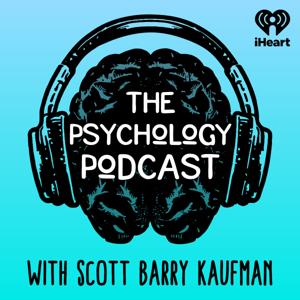
For eleven years and 478 episodes, Dr. Scott Barry Kaufman hosted The Psychology Podcast, one of the most listened-to psychology shows in the world, with more than 30 million downloads. Human…
The questions have moved. What is a mind? What makes something conscious? What happens to being human when the things we build start to look like minds themselves? Too much of the work is happening out of public view. In this new show, Dr. Scott Barry Kaufman sits down with the scientists, philosophers and technologists working at the frontier — the people whose work is actively deciding what we could become as a species.
Scott Barry Kaufman is a cognitive scientist and the founder of the Center for Human Potential. He holds a Ph.D. from Yale and an M.Phil. from Cambridge, has taught at Columbia, NYU and the University of Pennsylvania, and is the author or editor of twelve books, including Transcend, Ungifted, Wired to Create and Rise Above. New episodes every other week from October 28, 2026.
Ranked by our users in the last 21 days

43,359 Listeners

2,591 Listeners

823 Listeners

37 Listeners

678 Listeners

3,307 Listeners

10,137 Listeners

755 Listeners

12,722 Listeners

2,513 Listeners

1,382 Listeners

4,667 Listeners

1,898 Listeners

244 Listeners

8 Listeners

8 Listeners

14,366 Listeners

352 Listeners

63 Listeners

249 Listeners

142 Listeners

237 Listeners

1,550 Listeners

1,393 Listeners

839 Listeners

753 Listeners

63 Listeners

277 Listeners

159 Listeners

1,034 Listeners

18 Listeners

189 Listeners

59 Listeners

34 Listeners

26 Listeners