
Sign up to save your podcasts
Or



Based on Podcast App listening data
This one’s going to rock your world. In episode 132 of Overthink, Ellie and David dig into the earth for the third part of their four-part series on the elements. They discuss everything from earthworms and carbon dating to the “solidity” of the earth. They look to Foucault, Freud, and Husserl for insights about how the earth can act as a metaphor for the mind and for the past. They also wonder: Is the earth inert matter or a living being? And why do so many creation myths present humans as “made” of earth/clay/mud? So, what is it that we actually mean when we talk about earth as an element? In the bonus, your hosts talk think through Heidegger’s notion of ground and horizon, and the Western association of land with earth.
Works Discussed:
Michel Foucault, The Archeology of Knowledge
Martin Heidegger, “ The Origin of the Work of Art”
Edmund Husserl, Crisis of the European Sciences
David Macauley, Elemental Philosophy: Earth, Air, Fire, and Water as Environmental Ideas
Thomas Nail, Theory of the Earth
James Lovelock, Gaia hypothesis
Dorian Sagan and Lynn Margulis, “God, Gaia, and Biophilia”
Support the show
Substack | overthinkpod.substack.com
Website | overthinkpodcast.com
Instagram & Twitter | @overthink_pod
Email | [email protected]
YouTube | Overthink podcast
See Privacy Policy at https://art19.com/privacy and California Privacy Notice at https://art19.com/privacy#do-not-sell-my-info.
Oceans, baths, ponds, and amniotic sacs? In episode 131 of Overthink, David and Ellie take a deep dive into the topic of water as part of their four-part series on the elements. They discuss how all life begins in water, and the conceptual features of water, such as its fluidity and shapelessness. What did Thales of Miletus mean by ‘all is water’? How is water used as a metaphor for the Dao? And at what point does being in water go from feeling like Moana to feeling like Jaws? In the Patreon bonus segment, they talk about water as a symbol of purification, the significance of plate tectonics, and the relationship between AI and water usage.
Works Discussed:
Aristotle, On the Heavens
Francis Bacon, Novum Organum
Jamie Linton, What Is Water? The History of a Modern Abstraction
David Macauley, Elemental Philosophy: Earth, Air, Fire, and Water as Environmental Ideas
Anna Secor, “Spacetimeunconscious”
Neil Shubin, Your Inner Fish
Lao Tzu, Dao De Jing
Peter Godfrey Smith, Metazoa
Support the show
Substack | overthinkpod.substack.com
Website | overthinkpodcast.com
Instagram & Twitter | @overthink_pod
Email | [email protected]
YouTube | Overthink podcast
See Privacy Policy at https://art19.com/privacy and California Privacy Notice at https://art19.com/privacy#do-not-sell-my-info.
Are all fires inherently bad? In episode 130 of Overthink, David and Ellie launch a four-part series on the elements, starting off hot with fire. They look at the role of fire in Greek mythology (focusing on the myth of Prometheus), the evolution of humans’ relationship with fire, and fire’s role as the universal metaphor. Why did Prometheus steal fire from the Olympians and give it to humans? Why does Bachelard believe that fire is “the” philosophical element par excellence? How did Western culture turn fire from friend to foe? And what would a non-antagonistic relationship to fire look like? In the bonus, your hosts give their fiery takes on arson and pyromania.
Works Discussed:
Gaston Bachelard, The Psychoanalysis of Fire
Stephen J. Pyne, The Pyrocene
Stephen J. Pyne, “Fire in the mind: changing understandings of fire in Western civilization.”
Support the show
Substack | overthinkpod.substack.com
Website | overthinkpodcast.com
Instagram & Twitter | @overthink_pod
Email | [email protected]
YouTube | Overthink podcast
See Privacy Policy at https://art19.com/privacy and California Privacy Notice at https://art19.com/privacy#do-not-sell-my-info.
What value might there be in having fewer rules? In episode 129 of Overthink, Ellie and David talk to philosopher and host of Hi-Phi Nation Barry Lam about his book, Fewer Rules, Better People: The Case for Discretion. They discuss the problems with legalism and bureaucracy and the importance of discretion, as well as how the emergence of AI affects decision-making, and the negative impact of too many rules on our criminal justice system. Are we obliged to follow government rulings? Why is the ‘by the book bureaucrat’ the biggest villain of all? And how can we train people to make better discretionary decisions? In the bonus, your hosts consider the effects of decisions based on private morality and whether there are cultural differences in discretion.
Works Discussed:
Ronald Dworkin, Taking Rights Seriously
Barry Lam, Fewer Rules, Better People: The Case for Discretion
Plato, Crito
Support the show
Substack | overthinkpod.substack.com
Website | overthinkpodcast.com
Instagram & Twitter | @overthink_pod
Email | [email protected]
YouTube | Overthink podcast
See Privacy Policy at https://art19.com/privacy and California Privacy Notice at https://art19.com/privacy#do-not-sell-my-info.
Episode 128 – Cleanliness
How often should you shower to remain ‘clean’? How many times can you re-wear your jeans before they are considered ‘dirty’? In episode 128 of Overthink, Ellie and David take a look at cleanliness. They get into how humans have turned cleanliness into an art, and maybe even an obsession. Why are we so bothered by dirt? What is dirt, anyways? How are notions of dirtiness and cleanliness even into our symbolic systems, including language and religion? And what is up with TikTok’s obsession with the Clean Girl Aesthetic? As they tackle these questions, your hosts also explore the historical weaponisation of the concept of cleanliness against marginalised groups, such as queer people and people of color. In the bonus, Ellie and David discuss cleanliness as a social construct, the link between it and isolation, and Michel Serres’s ‘excremental theory’ of private property.
Works Discussed:
Bruce Bagemihl, Biological Exuberance
Dana Berthold, “Tidy Whiteness: A Genealogy of Race, Purity, and Hygiene”
L’Oreal Blackett, “In The “Hygiene Olympics” Black Folks Always Win — But Aren’t We Tired?”
Mary Douglas, Purity and Danger
Virginia Smith, Clean: A History of Personal Hygiene and Purity
Support the show
Substack | overthinkpod.substack.com
Website | overthinkpodcast.com
Instagram & Twitter | @overthink_pod
Email | [email protected]
YouTube | Overthink podcast
See Privacy Policy at https://art19.com/privacy and California Privacy Notice at https://art19.com/privacy#do-not-sell-my-info.
Is Trump’s presidential reign turning the US into an oligarchy? Or did the US fall into oligarchic rule many years ago? In episode 127 of Overthink, David and Ellie dive into what an oligarchy looks like, the dangers of a country’s power being in the hands of the wealthy few, and whether or not oligarchic rule is new for the US. They look to the ancient Greeks for ideas on which form of government is conducive to the good life and explore how Aristotle’s notion of pleonexia relates to the current state of the US. Your hosts investigate how oligarchy morphs into tyranny, and try to answer the question, “How can we resist an oligarchy?” In the bonus, Ellie and David look at the four different types of oligarchy discussed by Jeffrey Winters.
Works Discussed:
Aristotle, Politics
Gordon Arlen, “Aristotle and the problem of oligarchic harm: Insights for democracy”
Thom Hartmann, The Hidden History of American Oligarchy
Plato, Republic
Luke Winslow, Oligarchy in America
Jeffrey Winters, Oligarchy
Support the show
Substack | overthinkpod.substack.com
Website | overthinkpodcast.com
Instagram & Twitter | @overthink_pod
Email | [email protected]
YouTube | Overthink podcast
See Privacy Policy at https://art19.com/privacy and California Privacy Notice at https://art19.com/privacy#do-not-sell-my-info.
Lasers, fog machines, silent prayers…and don’t forget the ecstasy! In episode 126 of Overthink, Ellie and David dive into the experience of ecstasy. They look at interpretations of ecstasy in the tradition of mysticism, where ecstasy has been figured as a loss of self. How common are experiences of ecstasy? Are they limited to religious contexts, or are there alternate avenues for entering ecstatic states? And what about MDMA and its relation to rave culture? In the bonus, they explore how well ecstasy fits into William James’ framework for mystical states, and consider the relationship between ecstasy, reason, and age.
Works Discussed:
St. Teresa of Avila, The Life of St. Teresa of Jesus
Simon Critchley, On Mysticism: The Experience of Ecstasy
James Landau, “The Flesh of Raving”
Marghanita Laski, Everyday Ecstasy
Wilhelm Mayer-Gross, “The Phenomenology of Abnormal Emotions of Happiness”
Simon Reynolds, Generation Ecstasy
Summer Heights High (2007)
Support the show
Substack | overthinkpod.substack.com
Website | overthinkpodcast.com
Instagram & Twitter | @overthink_pod
Email | [email protected]
YouTube | Overthink podcast
See Privacy Policy at https://art19.com/privacy and California Privacy Notice at https://art19.com/privacy#do-not-sell-my-info.
How should we make sense of the Trump administration’s assault on Trans rights? In episode 125 of Overthink, Ellie and David talk to philosopher Talia Mae Bettcher about her new book Beyond Personhood: An Essay in Trans Philosophy, where she discusses everything from “genderphoria” to her notion of “reality enforcement” (a mechanism of transphobic oppression). In the interview, Dr. Bettcher expresses concerns about certain received views about trans identity, such as the “the wrong body” and “beyond the binary” views, which don’t capture the complexity of trans experiences. How can we move toward a more inclusive culture when it comes to trans identity? And, do we need to reject fundamental philosophical notions such as “person,” “self,” and “subject” in order to understand trans phoria? In the bonus, Ellie and David dive deeper into the idea of the interpersonal object and question whether or not the notion of the self is too far plagued by philosophical baggage and needs to be discarded.
Works Discussed:
Talia Mae Bettcher, Beyond Personhood: An Essay in Trans Philosophy
Talia Mae Bettcher, “Evil Deceivers and Make-Believers: On Transphobic Violence and the Politics of Illusion”
Jennifer Finney Boylan, “I’m a Transgender Woman. This Is Not the Metamorphosis I Was Expecting”
Dean Spade, Normal Life: Administrative Violence, Critical Trans Politics, and the Limits of Law
Perry Zurn, Andrea J. Pitts, Talia Mae Bettcher and PJ DiPietro, Trans Philosophy
Support the show
Substack | overthinkpod.substack.com
Website | overthinkpodcast.com
Instagram & Twitter | @overthink_pod
Email | [email protected]
YouTube | Overthink podcast
See Privacy Policy at https://art19.com/privacy and California Privacy Notice at https://art19.com/privacy#do-not-sell-my-info.
Our intuitions are never wrong… right? In episode 124 of Overthink, Ellie and David wonder what intuition actually is. Is it a gut feeling, a rational insight, or just a generalization from past experience? They talk about the role intuition has played in early modern philosophy (in the works of Descartes, Hume, and Mill), in phenomenology (in the philosophies of Husserl and Nishida), and in the philosophy of science (in the writings of Bachelard). They also call into question the use of intuitions in contemporary analytic philosophy while also highlighting analytic critiques of the use of intuition in philosophical discourse. So, the question is: Can we trust our intuitions or not? Are they reliable sources of knowledge, or do they just reveal our implicit biases and cultural stereotypes? Plus, in the bonus, they dive into the limits of intuition. They take a look at John Stuart Mill’s rebellion against intuition, the ableism involved in many analytic intuitions, and Foucault’s concept of historical epistemes.
Works Discussed:
Maria Rosa Antognazza and Marco Segala, “Intuition in the history of philosophy (what’s in it for philosophers today?)”
Gaston Bachelard, Rational Materialism
Gaston Bachelard, The Philosophy of No
Gaston Bachelard, The Rationalist Compromise
Immanuel Kant, The Critique of Pure Reason
John Stuart Mill, A System of Logic
Moti Mizrahi, “Your Appeals to Intuition Have No Power Here!”
Nishida Kitaro, Intuition and Reflection in Self-Consciousness
Support the show
Substack | overthinkpod.substack.com
Website | overthinkpodcast.com
Instagram & Twitter | @overthink_pod
Email | [email protected]
YouTube | Overthink podcast
See Privacy Policy at https://art19.com/privacy and California Privacy Notice at https://art19.com/privacy#do-not-sell-my-info.
It’s not you, it’s me… In episode 123 of Overthink, Ellie and David get into the highs and lows of breakups. What, if anything, is valuable about breakups? Does society’s emphasis on monogamy affect how we conceptualize the end of relationships? And what do you do if your ex still has your Netflix password? Your hosts discuss everything from breakups in the age of social media and chemical solutions to heartache to what the laws against domestic abuse and stalking can tell us about how society views breakups. Plus, in the bonus, they take a look at Kierkegaard’s love life and discuss whether it’s ever truly possible to breakup with someone for purely altruistic reasons.
Check out the episode's extended cut here!
Works Discussed:
Brian D Earp et. al, “If I Could Just Stop Loving You: Anti-Love Biotechnology and the Ethics of a Chemical Breakup”
Kelli María Korducki, Hard To Do: The Surprising, Feminist History of Breaking Up
Pilar Lopez-Cantero, “The Break-Up Check: Exploring Romantic Love through Relationship Terminations”
Ovid, Remedia Amoris
Deborah Tuerkheimer, “Breakups”
Jennifer Wilson, “The New Business of Breakups”
Support the show
Substack | overthinkpod.substack.com
Website | overthinkpodcast.com
Instagram & Twitter | @overthink_pod
Email | [email protected]
YouTube | Overthink podcast
See Privacy Policy at https://art19.com/privacy and California Privacy Notice at https://art19.com/privacy#do-not-sell-my-info.
From the publisher's feed
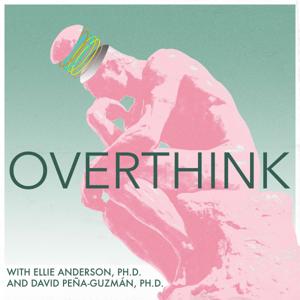
The best of all possible podcasts, Leibniz would say. Putting big ideas in dialogue with the everyday, Overthink offers accessible and fresh takes on philosophy from enthusiastic experts.…
Hosted by professors Ellie Anderson (Pomona College) and David M. Peña-Guzmán (San Francisco State University).
Ranked by our users in the last 21 days

43,827 Listeners

43,362 Listeners
15,235 Listeners

10,727 Listeners
2,112 Listeners
144 Listeners
10,144 Listeners
1,461 Listeners
1,540 Listeners
314 Listeners

5,527 Listeners
582 Listeners

1,343 Listeners

525 Listeners

745 Listeners

145 Listeners

582 Listeners

201 Listeners

1,237 Listeners

580 Listeners

502 Listeners

194 Listeners
285 Listeners

2,502 Listeners

94 Listeners
0 Listeners

79 Listeners
234 Listeners
712 Listeners

11 Listeners

315 Listeners

8,792 Listeners

360 Listeners

39 Listeners

26 Listeners