
Sign up to save your podcasts
Or



Based on Podcast App listening data
You might want to jot down some notes on this one! In episode 122, Ellie and David explore where writing began, the value of writing, and our reasons for writing. Is the widespread use of generative AI technologies, such as ChatGPT, a threat to creative and academic writing? How did writing originate in cuneiform, and how does Derrida's deconstruction of logocentrism encourage us to reconsider the privileging of speech over writing? Listen to it all write here, write now! Plus, in the bonus, they get into some of our most pernicious myths and misconceptions about writing. They talk about the tortured writer trope, the solitary nature of writing, and the connection of writing to class.
Check out the episode's extended cut here!
Works Discussed:
David Abram, The Spell of the Sensuous
Geoffrey Bennington and Jacques Derrida, Jacques Derrida
Jacques Derrida, “Freud and the Scene of Writing”
Jacques Derrida, Of Grammatology
Jacques Derrida, “Signature Event Context”
Jacques Derrida, Structure, Sign, and Play in the Discourse of the Human Sciences
Joan Didion, “Why I write”
Walter Ong, Orality and Literacy
George Orwell, “Why I write”
Plato, The Phaedrus
Alva Noë, The Entanglement, How Art and Philosophy Make Us Who We Are
Peter Salmon, An Event, Perhaps: A Biography of Jacques Derrida
Andrew Robinson, The Story of Writing
Support the show
Substack | overthinkpod.substack.com
Website | overthinkpodcast.com
Instagram & Twitter | @overthink_pod
Email | [email protected]
YouTube | Overthink podcast
See Privacy Policy at https://art19.com/privacy and California Privacy Notice at https://art19.com/privacy#do-not-sell-my-info.
In a world that has developed a collective fear of the dark, how can we navigate the not-so-positive feelings that we experience? In episode 121 of Overthink, Ellie and David chat with philosopher Mariana Alessandri about her book, Dark Moods. They talk about how the obsession with light fuels toxic positivity, the ways shame amplifies dark moods, and the harmful effects of associating light with good and darkness with bad. Why does society disregard negative emotions? Does the medical field pathologize grief for good reason? And should we strive to make people feel better when they’re experiencing a dark mood? Plus, in the Patreon bonus, they consider the difficulties of experiencing emotions that lie in a gray area, different types of anger, and whether we need to move away from metaphors of light and darkness entirely.
Check out the episode's extended cut here!
Works Discussed:
Mariana Alessandri, Night Vision, Seeing Ourselves Through Dark Moods
Gloria Anzaldúa, Borderlands/La Frontera: The New Mestiza
William James, The Varieties of Religious Experience
Plato, The Republic
Miguel de Unamuno, The Tragic Sense of Life
Support the show
Substack | overthinkpod.substack.com
Website | overthinkpodcast.com
Instagram & Twitter | @overthink_pod
Email | [email protected]
YouTube | Overthink podcast
See Privacy Policy at https://art19.com/privacy and California Privacy Notice at https://art19.com/privacy#do-not-sell-my-info.
From the holiday dinner table to the Twitter fandom wars, disagreements are inescapable. In episode 120 of Overthink, Ellie and David talk through different types of disagreement (e.g. disagreements online vs philosophical disagreements) and consider why we have such a tough time dealing with those who don’t see things as we do. Is the format of social media platforms to blame for the bad faith disagreements that occur on them? What role do confidence and conviction play in disagreement? Can we have a world without disagreement, or is disagreement an inevitable feature of our social lives? And how can we navigate the “shitstorm” when others refuse to agree with us? Prepare to turn on disagreement mode as you listen to two doctors of disagreement reason their way through it all. Plus, in the bonus, they discuss ways of overcoming disagreement, the failure of our education system, and the importance of community in online disagreement.
Check out the episode's extended cut here!
Works Discussed:
Byung-Chul Han, In the Swarm
Catherine Elgin, “Persistent Disagreement”
Mark Fisher, Capitalist Realism
Kathleen Kennedy, “When Disagreement Gets Ugly, Perceptions of Bias and the Escalation of Conflict”
Thomas Kuhn, The Structure of Scientific Revolutions
Alex J. Novikoff, The Medieval Culture of Disputation
Brian Ribeiro, “Philosophy and Disagreement”
Ludwig Wittgenstein, On Certainty
Support the show
Substack | overthinkpod.substack.com
Website | overthinkpodcast.com
Instagram & Twitter | @overthink_pod
Email | [email protected]
YouTube | Overthink podcast
See Privacy Policy at https://art19.com/privacy and California Privacy Notice at https://art19.com/privacy#do-not-sell-my-info.
Have you ever wanted to go on a road trip with the psychoanalyst Jacques Lacan? After listening to this episode, you certainly won’t! In episode 119 of Overthink, Ellie and David talk about the experience of driving and the moral and social dilemmas involved with it. How does driving alter our relationship with time and space? What is the “long distance truck driver problem”, and what does it have to do with animal consciousness? And how should we respond to the rise in self-driving cars? Buckle in and get ready for this ride into the philosophy of driving. Plus, in the bonus they dive deeper into the ethics of self-driving cars, exploring the repercussions hacking could have on self-driving cars. What moral philosophy should be programmed into the self-driving vehicles of the future? And who gets to decide?
Check out the episode's extended cut here!
Works Discussed:
David Armstrong, A Materialist Theory of The Mind
Kenneth Jackson, The Crabgrass Frontier
Stamatis Karnouskos, “Self-Driving Car Acceptance and the Rule of Ethics”
Maurice Merleau-Ponty, Phenomenology of Perception
Catherine Millot, Life with Lacan
Lynne Pearce, Drivetime
William Ratoff, “Self-driving Cars and the Right to Drive”
Mark Rowlands, Animal Rights: Moral Theory and Practice
Paul Virilio, Speed and Politics: An Essay on Dromology
Jamieson Webster, “Riding in Cars with Jacques Lacan”
Andreas Wolkenstein, “What has the Trolley Dilemma ever done for us (and what will it do in the future)? On some recent debates about the ethics of self- driving cars”
Support the show
Substack | overthinkpod.substack.com
Website | overthinkpodcast.com
Instagram & Twitter | @overthink_pod
Email | [email protected]
YouTube | Overthink podcast
See Privacy Policy at https://art19.com/privacy and California Privacy Notice at https://art19.com/privacy#do-not-sell-my-info.
Get comfy as you listen to this episode! In episode 118 of Overthink, Ellie and David discuss all things comfortable…and uncomfortable. They talk through the conflation of comfort and luxury, modern architecture’s prioritization of comfort, and whether our need for comfort is the reason for our burning planet. With everything from Maslow’s hierarchy of needs to “the comfort-industrial complex,” this episode will have you questioning what it takes for us to lead a full and happy life. Plus, in the bonus they get into the meaning of the phrase ‘too close for comfort’, alcohol as a destructive form of comfort, and the importance of attachment theory.
Check out the episode's extended cut here!
Works Discussed:
Daniel Barber, “After Comfort”
J L Bottorff et al., “The phenomenology of comfort”
Matt Haig, The Comfort Book
Ryan Heavy Head, “Blackfoot Influence on Abraham Maslow, Presented by Narcisse Kainai and Ryan Heavy Head at the University of Montana”
Lynnette Leeseberg Stamler and Ann Malinowski, “Comfort: exploration of the concept in nursing.”
A. H. Maslow, A Theory of Human Motivation
Teju Ravilochan, “The Blackfoot Wisdom that Inspired Maslow’s Hierarchy”.
Peter Sloterdijk, Spheres trilogy
Chögyam Trungpa, Shambhala: The Sacred Path of the Warrior
Support the show
Substack | overthinkpod.substack.com
Website | overthinkpodcast.com
Instagram & Twitter | @overthink_pod
Email | [email protected]
YouTube | Overthink podcast
See Privacy Policy at https://art19.com/privacy and California Privacy Notice at https://art19.com/privacy#do-not-sell-my-info.
Do you need black skin to be Black? How might concepts such as white privilege be limiting our understanding of how racism works? In Episode 117 of Overthink, Ellie and David chat with philosopher Lewis Gordon about his book, Fear of Black Consciousness. They talk through the history of anti-Black racism, the existential concept of bad faith, why Rachel Dolezal might have Black consciousness, and Frantz Fanon’s experience of being called a racial slur by a white child on a train. From the American Blues to the Caribbean movement of Negritude, this episode is full of insight into Black liberation and White centeredness. In the bonus, Ellie and David go into greater detail about how Black liberation is connected to love.
Check out the episode's extended cut here!
Works Discussed:
Steve Bantu Biko, I Write What I Like
W.E.B. Du Bois, The Souls of Black Folk
Frantz Fanon, Black Skin, White Masks
Edouard Glissant, Introduction à une Poétique du Divers
Jane Anna Gordon, “Legitimacy from Modernity’s Underside: Potentiated Double Consciousness”
Lewis Gordon, Bad Faith and Antiblack racism
Lewis Gordon, Fear of Black Consciousness
Rebecca Tuvel, “In Defense of Transracialism”
Support the show
Substack | overthinkpod.substack.com
Website | overthinkpodcast.com
Instagram & Twitter | @overthink_pod
Email | [email protected]
YouTube | Overthink podcast
See Privacy Policy at https://art19.com/privacy and California Privacy Notice at https://art19.com/privacy#do-not-sell-my-info.
Dinosaurs, mammoths, ibexes, frogs: a great deal of animals have gone the way of the dodo. Are we next? And would the world be better off without us? In Episode 116 of Overthink, Ellie and David talk about extinction, from Christian eschatology, to the perils of Anthropocene, to cutting-edge de-extinction technology. They turn to animal ethics and scientific dilemmas in search of the ethical approaches that might equip us to think about the extinction of animals, and perhaps even our own. Plus, in the bonus, they talk love, cyborgs, tech bros, and the ethics of the future.
Check out the episode's extended cut here!
Works Discussed
Thom Van Dooren, Flight Ways: Life and Loss at the Edge of Extinction
Elizabeth Kolbert, The Sixth Extinction: An Unnatural History
Todd May, Should We Go Extinct?
Jacob Sherkow and Henry Greely, “What if Extinction is not Forever?”
Émile Torres, Human Extinction: A History of the Science and Ethics of Annihilation
Children of Men (2006) dir. Alfonso Cuarón
Episode 46. Anti-Natalism
Support the show
Substack | overthinkpod.substack.com
Website | overthinkpodcast.com
Instagram & Twitter | @overthink_pod
Email | [email protected]
YouTube | Overthink podcast
See Privacy Policy at https://art19.com/privacy and California Privacy Notice at https://art19.com/privacy#do-not-sell-my-info.
It’s the one you’ve been hoping for. In episode 115 of Overthink, Ellie and David discuss the meaning of hope, from casual travel plans, to electoral optimism, to theological liberation. They discuss how hope motivates action, and how its rosy tint might be paralyzing. They explore Kant’s ambitions for perpetual peace, and discuss the Marxian imperative to transform the world. They ask, is it rational to hope? How does hoping relate to desire and expectation? And should we hope for what seems realistic, or reach for impossible utopias? Plus, in the bonus, they discuss chivalry, the future, agency, tenure, burritos, and capitalist realism.
Check out the episode's extended cut here!
Works Discussed
Augustine, Enchiridion on Faith, Hope and Love
Ernst Bloch, The Principle of Hope
Joseph J. Godfrey, A Philosophy of Human Hope
Immanuel Kant, Critique of Practical Reason, Religion Within The Limits of Reason Alone, Perpetual Peace
Jonathan Lear, Radical Hope: Ethics in the Face of Cultural Devastation
John Lysaker, Hope, Trust, and Forgiveness: Essays in Finitude
Adrienne Martin, How We Hope: A Moral Psychology
Karl Marx, Theses on Feuerbach
Anthony Steinbock, Moral Emotions: Reclaiming the Evidence of the Heart
Baruch Spinoza, Short Treatise
Katja Vogt, “Imagining Good Future States: Hope and Truth in Plato’s Philebus”
Support the show
Substack | overthinkpod.substack.com
Website | overthinkpodcast.com
Instagram & Twitter | @overthink_pod
Email | [email protected]
YouTube | Overthink podcast
See Privacy Policy at https://art19.com/privacy and California Privacy Notice at https://art19.com/privacy#do-not-sell-my-info.
Even with endless social scripts around romance, we hardly know what it means to be a good friend. In episode 114 of Overthink, Ellie and David reflect on the highs and lows of friendship, from their own bond to Montaigne’s intimate connection to Étienne de La Boétie. From Aristotle’s Nichomachean Ethics to today’s loneliness epidemic, they question what friends do, how they hold each other accountable, and the deep ways in which our vices and virtues are shaped by our friends. Plus, in the bonus, they talk Ralph Waldo Emerson, intimacy, dyadic relationships, high school friends, and… pluralectics?
Check out the episode's extended cut here!
Works Discussed
Aristotle, Nichomachean Ethics
Francis Bacon, “Of Friendship”
Lydia Denworth, Friendship: The Evolution, Biology, and Extraordinary Power of Life’s Fundamental Bond
Elijah Milgram, “Aristotle on Making Other Selves”
Michel de Montaigne, “Of Friendship”
Lawrence Thomas, “The Character of Friendship”
Support the show
Substack | overthinkpod.substack.com
Website | overthinkpodcast.com
Instagram & Twitter | @overthink_pod
Email | [email protected]
YouTube | Overthink podcast
See Privacy Policy at https://art19.com/privacy and California Privacy Notice at https://art19.com/privacy#do-not-sell-my-info.
Clogged toilets, odious jokes, difficult condolences… awkward moments are everywhere you look. In episode 113 of Overthink, Ellie and David invite philosopher Alexandra Plakias to talk through her research on awkwardness. They discuss everything from hasty clean-ups to snap decisions, from oversharing online to uncomfortable silences, as they explore the ways that awkwardness is bound up with power, morality, and the core scripts of our social expectations. Where does cringe end and awkwardness begin? Are we living through especially awkward times? Who gets to decide what is awkward? And, what if awkward people… don’t exist at all? Plus, in the bonus, they discuss The Office, weddings, weird eye contact, and more.
Check out the episode's extended cut here!
Works Discussed
Sara Ahmed, The Promise of Happiness
Adam Kotsko, Awkwardness
Alexandra Plakias, Awkwardness: A Theory & “Awkward? We’d Better Own it”
Thomas J. Spiegel, “Cringe”
YouGov poll, "Awkwardness"
Support the show
Substack | overthinkpod.substack.com
Website | overthinkpodcast.com
Instagram & Twitter | @overthink_pod
Email | [email protected]
YouTube | Overthink podcast
See Privacy Policy at https://art19.com/privacy and California Privacy Notice at https://art19.com/privacy#do-not-sell-my-info.
From the publisher's feed
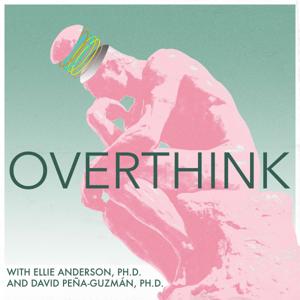
The best of all possible podcasts, Leibniz would say. Putting big ideas in dialogue with the everyday, Overthink offers accessible and fresh takes on philosophy from enthusiastic experts.…
Hosted by professors Ellie Anderson (Pomona College) and David M. Peña-Guzmán (San Francisco State University).
Ranked by our users in the last 21 days

43,827 Listeners

43,362 Listeners
15,235 Listeners
10,727 Listeners
2,112 Listeners
144 Listeners
10,144 Listeners
1,461 Listeners
1,540 Listeners
314 Listeners

5,527 Listeners
582 Listeners

1,343 Listeners
525 Listeners

745 Listeners
145 Listeners
582 Listeners

201 Listeners
1,237 Listeners

580 Listeners

502 Listeners
194 Listeners
285 Listeners

2,502 Listeners

94 Listeners
0 Listeners
79 Listeners
234 Listeners
712 Listeners

11 Listeners
315 Listeners
8,792 Listeners

360 Listeners
39 Listeners
26 Listeners