
Sign up to save your podcasts
Or



Based on Podcast App listening data
If you've ever spent an entire day performing a version of yourself that felt nothing like the real you — holding it together at work, seeming calm when you're not, passing as organized — you already know something about masking. But knowing it and understanding it are two different things. Dr. Sharon Saline returns to help Pete and Nikki unpack what masking actually is: hiding traits, suppressing impulses, and overcompensating to appear more polished than you feel. It's a coping mechanism that can be useful, but for adults with ADHD, chronic masking carries real costs — increased anxiety, emotional exhaustion, a growing disconnect between who you show the world and who you actually are.
One of the most important distinctions in this conversation is the difference between masking and presentation. We all show up differently in different contexts — there's a version of you at work, with close friends, with your partner. That's not masking; that's healthy. Masking is specifically about hiding, about a core sense of deficiency that says if people see the real me, they'll reject me. Sharon traces this directly to the social anxiety spectrum — and to the RSD, perfectionism, and imposter syndrome that so many with ADHD know intimately.
So what does it look like in practice? Saying yes when you mean no. Staying quiet when you have something to say. Overpreparing to look like you know everything so no one discovers you feel like you know nothing. And at work, pretending you have it all under control when you're drowning — rather than simply asking for what you need. Sharon draws a crucial line between protective masking (I will never feel safe here) and productive masking (I don't feel comfortable yet) — and that distinction is where the path forward starts to open up.
Lowering the mask isn't about tearing it off all at once. It's about identifying the patterns — the people and places where you've felt safe before — and using those as your guide. It's about noticing the physical sensation of safety when it shows up, and recognizing that you deserve spaces in your life where you don't have to perform in order to belong. Sharon also reminds us that for AuDHD people especially, masking has often been an essential survival tool, and that owning your challenges with honesty — and even humor — is ultimately far less exhausting than the alternative.
Links & Notes
It's not the blow-ups that do the most damage in a relationship — it's the quieter stuff. The look you misread, the deadline you missed again, the apology you've given so many times it stopped meaning anything. For those of us with ADHD, these small misconnections harden faster because we arrive already carrying a lifetime of being told we're too much or not enough. Dr. Dodge Rea is back to help us name what's really happening beneath the surface when relationships start to calcify.
Dodge walks us through the concept of misattunement — the challenge of being both intact and in touch at the same time — and why ADHD brains and neurotypical brains can miss each other without anyone being at fault. He shares a powerful reframe: "It's not your fault and it's not your fate, but it is yours." Both partners have ownership work to do, and it starts with putting down the shame long enough to actually talk about what's hard. From the kitchen stepladder analogy to his expanded Ferrari metaphor, Dodge offers language that makes the invisible patterns in ADHD relationships finally feel speakable.
Pete and Nikki bring their own experiences to the table — Pete on the fear of being "generalized forgetful" and Nikki on the compassion required from the non-ADHD partner. Together they explore why shame makes everything about your value, how all-or-nothing thinking accelerates the spiral, and what it looks like to meet your experience with authenticity instead of defensiveness.
Links & Notes
If you have ADHD, chances are you've developed a deeply ingrained habit of apologizing — for being late, for forgetting, for talking too long, for existing in a way that feels like an inconvenience. In this episode, Nikki and Pete unpack why over-apologizing is so common in the ADHD experience and how rejection sensitive dysphoria fuels the cycle. They explore what happens on the receiving end when apologies become emotional labor for someone else, and why pre-apologizing can actually undermine your credibility and prevent others from having their own authentic reactions.
The conversation moves from apology into repair — a critical distinction. Where an apology is one-directional, repair is a two-party activity built on acknowledging impact, taking responsibility, and resetting the relationship. Nikki walks through the framework of acknowledge, repair, reset, and Pete shares a powerful lesson from his own therapist: your power ends with your skin. You get to own your part, but you don't get to own someone else's forgiveness timeline. They also dig into why self-compassion isn't optional — it's the foundation that makes real repair possible.
This episode also comes with a free downloadable resource: "Repair Scripts for Real Life: The ADHD Repair Guide," featuring five ready-to-use scripts for situations that come up for ADHDers every single week. Grab your copy Right Here!
Links & Notes
Being called "low maintenance" feels like a win — until you realize the price you've been paying to earn it. In this episode, Pete and Nikki dig into why so many people with ADHD build their identity around not needing anything from anyone, and what happens when the bill comes due.
Pete defines maintenance as the information, time, supports, accommodations, and care that let you function without constant internal triage — and argues that nobody is maintenance free. Together they explore the privatized support behaviors that keep ADHDers silent: not asking for written instructions, not requesting deadline extensions while drowning, saying "whatever works for you" when you have strong preferences, and hiding the enormous effort required to look effortless.
The conversation introduces two low maintenance archetypes — the Ghost, who disappears when overwhelmed and returns like nothing happened, and the Fixer, who over-functions to become indispensable and then collapses. Pete and Nikki explore what both patterns cost: exhaustion, resentment, mystery anger, relationship distortion, and identity erosion.
This is an episode about learning to say "I matter" — two words that don't require a journaling practice or a checklist, just the courage to believe them. Plus, Nikki drops a powerful reframe: when you start asking for help, you open the door for others to do the same.
Download the Relearning Maintenance Worksheet that accompanies this episode right here!
Links & Notes
This episode turns into a stealth self-care intervention when James Ochoa joins Pete and Nikki and immediately drags “motivation” out of the tidy, planner-friendly realm and into the messy, bodily reality of fear, avoidance, and chronic stress. They start with the familiar ADHD paradox—knowing exactly what to do and still not being able to do it—and James reframes that stuckness as normal rather than shameful, then introduces “resourcing” as the practical antidote: not a single trick, but layered supports (internal and external) that make motion possible even when meaning, willpower, and good intentions aren’t showing up.
From there, the conversation gets uncomfortably specific in the best way, as Pete uses a long-avoided dermatologist appointment to walk through what “functional pressure” and relationship-based accountability can look like in real time. They explore why the hardest part is often the moment before the call, why eight-out-of-ten certainty is a workable target, and how to build a personal “wind-making” kit—scripts, sensory cues, body movement, tiny rituals, and other anchors that help you cross the threshold from uncertainty to action. The live chat brings in real-world complications (sleep issues, pain, dental trauma, AuDHD scripting and emotion tagging), and James offers concrete, compassionate ways to get support without muscling through alone—because the point isn’t to never fall off the wagon, it’s to get better at restarting.
Links & Notes
That “this year will be different” promise feels so good when it’s fresh… and so brutal when the old patterns quietly return. In this episode, Pete and Nikki unpack why that boom-and-bust cycle hits so hard for ADHD brains: the early dopamine of a new system (or a newly organized sock drawer), the unrealistic maintenance expectations baked into most productivity advice, and the emotional crash that follows when the setup doesn’t hold.
They dig into the real trap underneath the resolution mindset—living in the gap between who you were yesterday and who you hope to be tomorrow—and how to pull your attention back to the only place you actually have leverage: today. Along the way, they talk about why asking for help can feel so risky (hello, shame and RSD), how to regulate before you ask, and what it looks like to reframe help as advocacy instead of rescue. The goal isn’t becoming someone new. It’s learning to support the person you already are, with more time, more buffer, and a lot less self-punishment.
Links & Notes
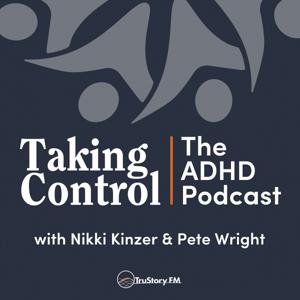
When you're running on empty, your emotions hit harder and last longer. This week on Taking Control: The ADHD Podcast, Pete and Nikki explore what happens to emotional regulation when you're already depleted—and what you can actually do about it.
Building on last week's conversation about compassionate reframing, this episode dives into the physiology behind emotional dysregulation and RSD (Rejection Sensitive Dysphoria). Pete shares insights from the polyvagal theory and the concept of the "vagal brake," explaining why breathing alone isn't enough when you're in fight-or-flight mode.
Nikki breaks down the differences between emotional regulation, emotional dysregulation, and RSD with real examples that anyone with ADHD will recognize. Then they walk through practical grounding techniques that actually work—from ice cold water to wall push-ups to finding safe connection with others.
You'll learn why your ADHD brain feels emotions at 100% when others are at 50%, why that negative comment from ten years ago still lives rent-free in your head, and how to create safety for your nervous system when you're already overwhelmed.
Plus, get the free downloadable guide: "Regulate and Reframe: A Guide for Emotional Dysregulation and RSD" with simple tools to help you ground, reset, and find your way back to safety.
Links & Notes
Pete and Nikki kick off the new season by naming the thing nobody wants to put on a vision board: the post-holiday crash. If you’ve come out the other side feeling “behind,” they argue you’re not failing—you’re recovering. And because ADHD loves a transition about as much as it loves a quiet restaurant, that return-to-normal whiplash can hit harder than you expect.
The temptation, of course, is to fix the feeling by buying a brand-new feeling: new planner, new system, new you, new personality, new carbon-based lifeform. Nikki gently drags that impulse into the daylight and offers a more realistic move—skip the reinvention and reestablish one anchor routine you already know helps. Something small, repeatable, and boring in the way that’s actually useful, whether it’s hydration, an end-of-day reset, or getting sleep back on purpose instead of by accident.
They also lean into compassionate reframing—swapping the “I blew it” narrative for language that’s both true and less cruel—because shame is a famously unreliable productivity tool. There’s a new resource tied to that idea, too, and it’s meant to be the quick handrail you grab when January starts acting like a performance review.
Links & Notes
📃 Download Compassionate Reframing for the ADHD Brain
To close out Season 31, we turned the microphones over to someone who knows us better than almost anyone in our community: Melissa Bacheler, our DiscordMom, friend, and occasional chaos agent. Instead of the usual coaching, planning, and problem-solving, Melissa surprises us with a full-blown quiz-show-style conversation designed to reveal stories we’ve never told on air. No points, no pressure—just questions that spark nostalgia, laughter, and a surprising amount of self-reflection.
Melissa steers us through three big categories: personal hobbies, memories from childhood and adolescence, and a handful of wildly imaginative “what if” scenarios. Nikki talks about her deep love of puzzles, watercolor, country music, and solitude. Pete shares his affection for filmmaking, collaborative storytelling, woodworking, and turning every car he’s ever owned into a “Doctor.” Together, they trade stories about childhood fears, nicknames that should never have been uttered in public, their dream cars, early celebrity crushes, and the music that scored each decade of their lives.
And then Melissa goes for the big swings: Who would coach Pete if he could choose any fictional character? How would Nikki run the show if Pete were abducted by aliens—or voluntarily uploaded to the cloud, which frankly sounds inevitable? The answers—if you’ve listened to the show long enough—are deeply on brand.
This is a relaxed end-of-season celebration with the person who keeps our Discord running and our community grounded. Thank you for an incredible Season 31—and yes, Season 32 begins in the new year!
Links & Notes
Emotional planning sounds like one of those concepts you think you already understand — until you realize it has nothing to do with mood journaling, crystal grids, or color-coding your feelings. What Nikki brings forward in this conversation is something far more practical: the idea that ADHD motivation doesn’t start with logic. It starts with emotion. And if we learn to work with that reality instead of trying to muscle our way through it, the whole experience of getting things done changes.
This episode was sparked by a discussion inside GPS, where members were reflecting on our earlier conversation with financial coach Nicole Stanley. Nicole talked about how emotionally meaningful goals are the ones we actually stick with — even when motivation falters. That hit a nerve. If emotional meaning helps us save money, why can’t it help us take out the trash, send the email, or finally make that dreaded insurance phone call?
From there, Nikki pulls the curtain back on the truth most ADHDers already know in their bones: motivation isn’t something you summon by force. You can’t shame yourself into momentum. You can’t logic your way into action. And no amount of telling yourself you “should just do it” will magically conjure wind in your sails.
We talk instead about how to invite motivation in: through novelty, stimulation, environment shifts, sensory comfort, short timers, playful challenges, and co-working with others who get it. We look closely at body doubling — not as a trend, but as an ADHD-power-tool that reliably flips the activation switch for so many of us. We explore how accountability creates connection, how structure eases initiation, and how changing a setting (or a soundtrack… or even a pen) can lighten the emotional load of tasks we avoid.
And finally, we dig into the heart of emotional planning: identifying meaning in the task itself. Not fake meaning, not “I should care about this,” but real alignment — who benefits, what value the task honors, and how it makes life easier for future you. By the time Pete unexpectedly processes his own insurance-related avoidance live on the show, emotional planning has become more than a coaching tool. It’s a reframing — one that reminds us that motivation isn’t a moral quality; it’s a relationship between emotion and action.
If you’ve been stuck, stalled, circling a task like it’s a shark in shallow water, this episode gives you both language and strategy to step toward it with less dread. It’s not about forcing motivation. It’s about building the conditions where motivation has an easier time finding you.
Links & Notes
From the publisher's feed

1,327 Listeners
908 Listeners

8 Listeners
118 Listeners

21 Listeners
32 Listeners

2,876 Listeners

37 Listeners
710 Listeners
38 Listeners

29 Listeners

12 Listeners
173 Listeners

100 Listeners
175 Listeners

19,009 Listeners

283 Listeners
98 Listeners

27 Listeners
378 Listeners

4 Listeners
2 Listeners

8 Listeners

282 Listeners

0 Listeners

69 Listeners

6 Listeners

0 Listeners

5 Listeners

8 Listeners

0 Listeners

0 Listeners
2 Listeners