
Sign up to save your podcasts
Or



Based on Podcast App listening data
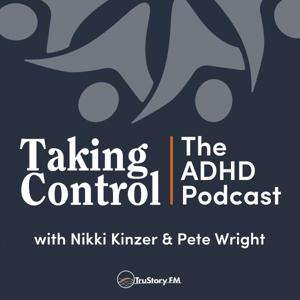
We're on summer break, so this week is a Revisit: a favorite conversation pulled back out of the archive. The idea takes after Dr. Kurosh Dini's concept of the visit, showing up to something with curiosity rather than judgment.
In this one, we talk with coach Jane Massengill about the negative self-talk that so many people with ADHD carry, why it can run louder for us, and a simple practice she calls word watching for catching it in the moment. It's a warm, useful conversation about learning to be kinder to yourself. Whether it's your first listen or a return trip, it's worth your time.
Links & Notes
At the end of the day, when your brain starts tallying everything you didn't finish, where's the credit for everything you did? In the Season 32 finale, we close out the season on the quiet skill that gets buried under all that mental accounting — noticing your progress instead of measuring it.
The unfinished stuff is loud: the laundry pile, the twenty-item list, the messages still waiting. The progress is silent, and a lifetime of report cards and performance reviews has trained us to see only what's left. We get into why that happens — with a detour through a 1927 psychology experiment that explains a lot about the ADHD shame loop — what self-compassion actually looks like in a real day, and why the answer isn't a shinier scorecard. Plus a family-dinner ritual worth stealing, an optical illusion that makes the whole point, and one of the more memorable cold opens of the season.
It's our send-off into summer break, and a reminder that sometimes the entire practice fits into one word.
Links & Notes
You can lose six hours to the thing that lights you up, then completely stall on a task that takes three minutes. Same brain, different room. In this conversation, Pete and Nikki get into why ADHD shows up hard in one setting and nearly disappears in another, why "broken" is the wrong word for any of it, and what changes when you stop asking how to fix yourself and start paying attention to the rooms where you do your best work. It's the capper on a season-long conversation about living with ADHD instead of fighting it, and a grounded look at the context, fuel, and environment that make hard things doable.
Links & Notes
You can have the perfect planner, the right system, and the best intentions, and still not follow through. It isn't a caring problem. After enough broken promises to yourself, some quiet part of you simply stops believing the plan. That's where this conversation with Dr. Tamara Rosier begins, and it reframes self-trust as something closer to a nervous system skill than a mindset you can think your way into.
Dr. Tamara Rosier has written the books and built the center and stood on the stages, and she still wakes some mornings and reminds herself, deliberately, that she is a trustworthy person. The belief underneath — the one she's carried since she was small — is that she's a person who screws things up. ADHD feeds a belief like that. It chips away at your sense of who you are, one forgotten thing at a time, until distrusting yourself stops feeling like a wound and starts feeling like good judgment.
So much of that, it turns out, is happening in the body. An ADHD nervous system can spend its whole life braced — fight, flight, freeze, appease — switched on and calling it normal because it has never known the alternative. For years Tamara sat frozen on the couch, melting into the cushions, sure she was resting, when she was really stuck somewhere below the place where rest actually lives. There's a narrow band where you're calm and awake at once, and a lot of us have never spent much time there. Hearing her describe it, you may quietly start to wonder whether you ever have.
The way back looks like catching yourself mid-loop — Tamara tells it through the week she lost one of her chickens, and the refrain that trailed her around the house, I failed her, I failed her, I failed her — and then learning to talk back to it, to move your body, to put on the Motown, to do the next small thing that nudges you up out of the freeze. It looks like noticing the clever ways we avoid all of that, too: the new app, the next fix, the dopamine that keeps us busy on the surface so we never have to turn toward the thing underneath.
And the hope here is almost disappointingly ordinary. No system is going to fix you by Thursday. What there is, instead, is the small correction, made again and again, the way a sailor nudges the tiller rather than wrenching the whole boat around and tipping it over. There's learning to read your own weather, hour by hour. There's accepting that you may always need the timer, the Post-it, the reminder, and letting that be fine rather than shameful. Self-trust grows in that soil — in the quiet, stubborn belief that whatever goes sideways today, you'll know how to repair it.
Links & Notes
There's a rule most of us signed before we could read it. It decides whether we're worth anything, and it tends to set the same terms for everyone who carries an ADHD brain: you're valuable if you perform, if you keep every plate spinning, if you never let anyone down. Live under that contract long enough and it stops feeling like a belief and starts feeling like a fact — written, as the metaphor goes this week, in permanent ink.
Where did the rule come from? Often from the earliest lessons — the pulled-out-of-class, extra-time, here-are-your-accommodations lessons that were meant to level the field but landed as proof you were different. The gap they leave behind doesn't shrink with age. There's research suggesting it widens. The assumption that everyone else has this figured out turns out to be the lie that keeps the rule in place.
Links & Notes
"Good enough" is a phrase that can land like permission or like an accusation — and for ADHD brains that have spent a lifetime being told we're not trying hard enough, both feelings often arrive at once.
This week, we're untangling that knot. Why does a phrase meant to release us so often feel like settling? Why does the ADHD brain hear "good enough" and translate it into "not enough"? And what would it actually take to reclaim the phrase as our own?
This is really all about intention — the difference between walking away from something because you've been defeated by it, and walking away because you've made a choice. One leaves you smaller. The other builds something. We talk about the standards we measure ourselves against (almost always invented), the freeze that comes when nothing feels possible, and the small, almost invisible acts that count as progress even when they don't feel like it.
By the end, we land somewhere unexpectedly tender: a reminder that the way we build trust with ourselves isn't by finishing things perfectly. It's by finishing them at all.
There's a free download this week — five questions to help you decide what's good enough — linked below.
Links & Notes
There's a kind of waiting most ADHDers know well — waiting for someone, somewhere, to say it's okay. Okay to rest. Okay to stop masking. Okay to take the accommodation. Okay to want what you want without justifying it.
In this conversation, we get into the permission slips we keep waiting for, often from authority figures who may not even exist anymore. We talk about why ADHDers wait — the research-backed link between years of childhood correction and adult reliance on external validation — and what that has to do with decision paralysis, rejection sensitivity, masking, and the exhaustion of performing a version of yourself that you didn't sign up for.
Plus the swan, self-determination theory, and a small concrete first step you can try this week.
Links & Notes
We've all been there: someone offers a perfectly reasonable suggestion, and instead of taking it in, you bristle. You're tired. You're cranky. The last thing you want is advice. This week, Pete and Nikki tackle what happens when ADHD meets fatigue — and why the strategies that usually work suddenly don't.
This isn't laziness. It isn't a character flaw. It's what happens when executive functions are already running on a deficit and you pile fatigue on top. Pete brings the research, including a study showing 62% of adults with ADHD meet the criteria for chronic fatigue syndrome — a reminder that "everybody gets tired" is true, but ADHD brains get tired in a different and vastly more significant way.
The conversation moves from the science to the lived experience: the guilt loop that keeps you from resting, the way fatigue distorts reality until small tasks feel like moral referendums, and the rewiring required to treat recovery as part of the work — not a reward you have to earn.
Plus: why "I don't wanna" might be a capacity check in disguise, the four categories of recovery that actually work (hint: sleep is only one of them), and Nikki's insight that the recovery muscle is built through trial and error, not advance planning.
LINKS & RESOURCES
We've all said it. "I'll deal with it later." And somehow, later never comes. The thing just sits there — not in your calendar, but in your head. It pings you in the shower. It shows up right before you fall asleep. That's an energy leak.
This week, Ari Tuckman returns for his sixth appearance to unpack what's actually happening when we tell ourselves "later." What is the ADHD brain doing in that moment? Are we making a real decision, or just kicking the can? And how do we tell the difference?
We dig into:
Guest Spotlight
Ari Tuckman, PsyD is a psychologist, author, and international presenter specializing in ADHD. He's given more than 600 presentations and podcast interviews across America and nine other countries, and is the author of four books: ADHD After Dark, Understand Your Brain, Get More Done, More Attention, Less Deficit, and Integrative Treatment for Adult ADHD. He chairs the CHADD Conference Committee. This is his sixth appearance on the show.
Links & Notes
You've heard it before, probably said it yourself: time blocking doesn't work for me. Every block that slips becomes one more piece of evidence that you've failed the system — or that the system has failed you. So this week, Nikki and Pete try something different. They change the word.
Nikki walks through three terms that get thrown around in planning circles — intentional planning, time blocking, and the one she's been reaching for more and more lately: flexible scheduling. Pete pushes back (gently, mostly) on why we need a new word for something that was never supposed to be rigid in the first place. And together they unpack the real reason so many ADHDers bounce off scheduling: it's not the strategy, it's the story we tell ourselves when the strategy bends.
Along the way: the dangerous allure of hyperscheduling and why it only really works if your livelihood is measured in billable minutes; why time blindness isn't a reason to skip time blocking (and why estimation was never the point); the spoon theory and scheduling around energy instead of just hours; and Pete's brand-new metaphor — age of time — for thinking about margin, buffer, and what it feels like to live three weeks ahead of yourself instead of one day behind.
Plus, Nikki drops another download: Your ADHD Schedule Starter, a short, practical guide for building a flexible schedule step by step, with a reflection section built in so you can keep adjusting as you go. Link in the show notes.
Links & Notes
From the publisher's feed
Ranked by our users in the last 21 days

1,329 Listeners
909 Listeners

8 Listeners
119 Listeners

21 Listeners

34 Listeners
2,872 Listeners

37 Listeners
711 Listeners
38 Listeners

29 Listeners

12 Listeners
173 Listeners

100 Listeners
176 Listeners

19,246 Listeners

284 Listeners
97 Listeners

24 Listeners
380 Listeners

4 Listeners

2 Listeners

8 Listeners

281 Listeners

0 Listeners

69 Listeners

6 Listeners

0 Listeners

5 Listeners

8 Listeners

0 Listeners

0 Listeners
2 Listeners