
Sign up to save your podcasts
Or



Based on Podcast App listening data
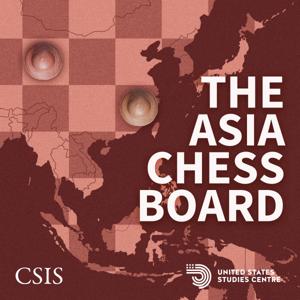
Lynchpin of ASEAN and sitting astride some of the globe’s most important sea lines of communications, Indonesia is a critical part of the Asia Chessboard. Mike is joined by former Indonesian ambassador to the U.S. Dr. Dino Djalal to discuss Indonesia’s strategic culture and relationship with the U.S. How is Indonesia managing U.S.-China strategic competition? How does the next generation of Indonesian strategic thinkers view Indonesia’s place in the region and its relationships with Indo-Pacific great powers?
As strategic competition between the U.S. and China heats up, old Cold War-era questions on the importance of values are being asked anew: to what extent does ideology, democracy in particular, factor into U.S. foreign policy in Asia? Mike is joined by Ambassador Derek Mitchell of the National Democratic Institute and Dr. Dan Twining of the International Republican Institute to dive into the past, present, and future roles of democracy support in U.S. Asia policy. The three begin by discussing the cliched idea that the U.S. must always choose between promotion of its values and defense of its hard interests. Mike, Derek, and Dan then turn to how the U.S. should approach Asian allies whose democratic institutions are under attack domestically and from abroad. The trio conclude the discussion by examining how the U.S. might encourage its democratic allies in Asia to see how support for democratic governance benefits their own security concerns.
Mike sits down with Keio University professor Yuichi Hosoya to discuss one of the longest-tenured players on the Asia chessboard, Japanese Prime Minister Shinzo Abe. Mike and Yuichi kick off the episode by discussing Yuichi’s role as both an academic and an informal adviser to the Abe government on foreign policy. The two then turn to discussing how history and foreign policy are taught in Japanese universities. The conversation then moves towards analyzing the cornerstone of Abe’s contribution to the Asia chessboard, the Free and Open Indo-Pacific (FOIP). What does FOIP mean to Japan and to Abe? Is it fair to characterize FOIP as a counter-China strategy? What is ASEAN’s role in FOIP, and how should the U.S. understand FOIP’s evolution with the present thaw between Japan and China?
In the first episode of 2020, Mike is joined by Tom Karako, Senior Fellow with the CSIS International Security Program and Director of the Missile Defense Project. Mike and Tom tackle the new hard power reality facing the Asia chessboard. What will the Indo-Pacific region look like now that the U.S. is no longer bound by the INF treaty? Mike and Tom also examine the doctrinal, strategic, and political realities of deploying intermediate-range missiles. They conclude by examining how possible U.S. missile deployments may affect the broader geopolitical dynamics of the Indo-Pacific and the prospects for future arms control agreements.
Mike is joined in this episode by Patrick Buchan, director of the U.S. Alliances Project and Fellow for Indo-Pacific security at CSIS. Buchan is also a former official with the Australian Department of Defense, Department of Prime Minister and Cabinet, and the U.S. Office of the Secretary of Defense. After discussing Pat’s unique background as an Australian seconded to the U.S. government, Mike and Pat move towards discussing one of America’s Indo-Pacific allies, Australia. What are the origins of Australian grand strategy? How does Australia’s role as a “Five Eyes” ally impact its ability to affect American planning and strategy? How do both the U.S. and Australia handle areas of divergence between their interests? Finally, Mike and Pat evaluate Australia’s recent efforts to network with other “spokes” in the U.S.-led hub and spoke alliance system in the Indo-Pacific.
Amid the on-again, off-again trade deal with China and roiling protests in Hong Kong, Mike is joined by Ambassador Kurt Tong, partner at The Asia Group, former Consul General in Hong Kong and Macau, and former State Department Principal Deputy Assistant Secretary for Economic and Business Affairs. Mike and Kurt kick off the discussion with a look at Kurt's background. They also discuss how U.S. economic policy fits into a larger grand strategy picture in Asia. The conversation ends with a reflection on Kurt's tenure as Consul General in Hong Kong looking at the protests, the recent District Council elections, and the government's response.
On July 16, 2024, the U.S. Department of Justice unsealed an indictment charging Sue Mi Terry with violations of the Foreign Agents Registration Act. The indictment alleges activities that took place, in part, during a period in which Ms. Terry was employed by the Center for Strategic and International Studies. CSIS is not a party to this litigation and takes the allegations seriously. CSIS maintains strict policies to ensure full compliance with the Foreign Agents Registration Act and the intellectual independence of its scholarship. In light of these serious allegations, CSIS cannot verify the independence of the scholarship of this material containing the views of Ms. Terry and has therefore archived this content pending the resolution of the charges.
Mike is joined by Dr. Kath Hicks, Henry Kissinger Chair, Senior Vice President, and Director of the International Security Program at CSIS, for a discussion of how "gray zone" tactics factor into grand strategy in Asia. In unpacking the effect of gray zone tactics on strategy, Mike and Kath define the parameters of gray zone tactics and the domains in which they are most effective. With these assumptions in mind, what will the knock-on effects of gray zone tactics be on theories of coercion, victory, and defense planning in Asia? What parts of the U.S. government have historically been most effective at adapting to gray zone competition? Mike and Kath further discuss Kath's journey through the Department of Defense and her advice for young women hoping to become defense professionals.
From the publisher's feed
Ranked by our users in the last 21 days
251 Listeners

601 Listeners

1,067 Listeners
316 Listeners
143 Listeners
603 Listeners
206 Listeners

764 Listeners
717 Listeners
2 Listeners
288 Listeners
153 Listeners
423 Listeners

6 Listeners
85 Listeners
17 Listeners
402 Listeners
1 Listeners
140 Listeners

22 Listeners
25 Listeners
4 Listeners
470 Listeners
2 Listeners

5 Listeners
266 Listeners
47 Listeners
157 Listeners

0 Listeners

3 Listeners
13 Listeners
9 Listeners
3 Listeners

0 Listeners