
Sign up to save your podcasts
Or



When we think about Type 1 Diabetes, much of the conversation focuses on glucose management and insulin. But for some people, the demands of living with diabetes can also impact their relationship with diet, weight, and body image.
In this episode, we'll explore how dietitians can identify potential eating difficulties, navigate sensitive conversations, assess risk, and support individuals living with Type 1 Diabetes. We'll also examine how these issues can present across the lifespan, bringing together both adult and paediatric perspectives to discuss prevention, intervention, and multidisciplinary care.
We have Sarah Alicea and Aisling Pigott here with us today to discuss this further.
Sarah Alicea is a clinical academic dietitian specialising in diabetes care, with specialist expertise in Type 1 diabetes and disordered eating (T1DE). At Barts Health NHS Trust, she is Clinical Lead for Diabetes and Disordered Eating and a Doctoral Researcher at the University of Warwick, where she is developing a screening tool to improve identification of disordered eating in people with Type 1 diabetes. She has contributed to diabetes care nationally through guideline development and professional education, including as a member of the NICE Diabetes Quality Standards Committee and co-lead author of the 2021 Best Practice in the Delivery of Diabetes Care in the Primary Care Network guidance. She founded a T1DE-focused e-learning platform for clinicians and established a UK-wide professional supervision group to support healthcare professionals working in this specialist area. Sarah is also Vice Chair of the Diabetes UK Professional Conference Organising Committee and former Chair of the British Dietetic Association (BDA) Diabetes Specialist Group, where she continues as Research Lead. Her work focuses on translating diabetes evidence into meaningful conversations with people with lived experience, and supporting healthcare professionals to do the same.
Aising Pigott is a Registered Dietitian, Senior Lecturer and Doctoral Researcher at Cardiff Metropolitan University. She is also a Non-Executive Director at the British Dietetic Association (BDA) and chair of the Professional Committee. Aisling's background is in Paediatric Diabetes, and her research explores eating disorder prevention in diabetes care. Aisling is also a spokesperson for the British Dietetic Association with regular media exposure on TV, radio, and print.
Sarah’s LinkedIn: Sarah Alicea | LinkedIn
Aisling’s LinkedIn: Aisling Pigott | LinkedIn
What if one of the biggest opportunities to improve the UK’s health starts with something as simple as eating more fibre? In this episode, we explore the journey behind Whitworths’ From Gaps to Gains paper, from identifying nutrient gaps in the UK to taking the conversation to policymakers in Westminster. We’ll explore what it really takes to turn nutrition evidence into action, how policy can help drive change at scale, and where dietitians and nutrition professionals fit into that bigger picture.
Taking us on this journey today is Phil Gowland, Commercial Director and Director of Health at Whitworths, the UK’s leading supplier of dried fruit, nuts and seeds. He is helping to transform the company from a traditional food manufacturer into a purpose-led health business, guided by its ambition to fuel health and reduce disease—one bite at a time.
Phil works at the intersection of commercial strategy, nutrition science and public health. He has led major research and policy initiatives examining how greater consumption of nuts, seeds and dried fruit could help close the UK’s nutritional gaps and reduce the burden of preventable disease. His work includes engagement with government, health organisations, academics and major UK retailers to help make healthier food choices more accessible.
He is also a board member of the National Dried Fruit Trade Association, Chair of the FRUCOM Nutrition Committee and Nesta Board advisor.
Phil’s LinkedIn: Phil Gowland | LinkedIn
From Gaps to Gains Report: From Gaps To Gains.pdf - Google Drive
Food allergy care in children often centres around safety and avoidance, but where is the line between necessary protection and unnecessary restriction? With the introduction of the UK’s National Allergy Strategy, the conversation is shifting beyond individual responsibility to a broader focus on consistency, support, and quality of life. In this episode, we explore the balance between keeping children safe and helping them develop a more normal, flexible relationship with food, and what that looks like in real-world practice.
Joining Kate today to explore this in more depth is Professor Adam Fox and Professor Rosan Meyer.
Show Notes
Rosan’s LinkedIn: Rosan Meyer | LinkedIn
Adam’s LinkedIn: Professor Adam Fox OBE | LinkedIn
National Allergy Strategy: National Allergy Strategy
Adam read Medicine at Cambridge University and is Professor of Paediatric Allergy at King's College London and Consultant Paediatric Allergist at Evelina London Children's Hospital. At Guy's & St Thomas' NHS Foundation Trust, he served nine years as Clinical Lead for Allergy, three as Clinical Director for Specialist Ambulatory Services, and five as Deputy Medical Director (Commercial). He was founding Director of the KCL Allergy Academy, a postgraduate programme and BMJ Awards finalist in 2018.
From 2018 to 2021, Adam was President of the British Society of Allergy & Clinical Immunology — the first paediatrician elected to the role. Since 2022 he has chaired the National Allergy Strategy Group, jointly chairs the Department of Health & Social Care's Expert Advisory Group for Allergy, and leads the 2025–35 National Allergy Strategy.
With Profs Gideon Lack and George Du Toit, he established The Allergy Centre of Excellence at Great Ormond Street Hospital in 2021, before opening their own premises in London's prestigious Harley Street Medical District in 2025, offering cutting-edge allergy diagnostics and treatments.
Adam was named Allergy UK's 'Paediatric Allergist of the Year' (2007), received Cambridge University's Raymond Horton Smith Prize for his doctoral thesis on peanut allergy (2012), and featured in The Times' 'Britain's 100 Best Children's Doctors'. He received the William Frankland Award for Outstanding Contribution to Allergy (2015), Department of Health National Clinical Excellence Awards (2016, 2020), and in 2024 became only the second recipient of the BSACI Fellows Award for outstanding contribution to clinical allergy. In 2025, he was awarded an OBE for services to Paediatric Allergy in the King's Birthday Honours and included in the Tatler Doctors List (2013 & 2026) of the UK's best private medical consultants.
Rosan is a specialist paediatric dietitian, who has almost 30 years of experience in paediatric nutrition. She qualified as a dietitian in South Africa in 1996 and then completed her paediatric dietetic training in the UK in 2000. She has both an MSc and PhD, which she completed at Imperial College London in 2008 and has worked at St. Mary’s Hospital London, as lead paediatric dietitian before becoming the principal research dietitian for the gastro-allergy at Great Ormond Street Hospital until 2015. She is CEO of StepbyStepKidzNutrition Ltd, which is a paediatric dietetic practice that has multiple specialist paediatric dietitians specialising in food hypersensitivity, growth faltering and the spectrum of aversive eating. Rosan has more than > 100 peer reviewed publications and is the co-author of the Paediatric Clinical Dietetics Pocket Guide. She was the co-module leader for the Food Hypersensitivity Module of the MSc in Allergy at Imperial College from 2008 – 2023 and is currently visiting Professor at KU Leuven, on their MSc on swallow disorders and leading the ARFID course together with ARFID Awareness with University of Huddersfield. She is one of the research dietitians on the NIHR funded study on establishing test directed management of eczema and leads multiple task forces for the European Academy for Allergy and Clinical Immunology.
Today’s topic is one that tends to fly under the radar in health and nutrition conversations, but deserves more attention.
When it comes to protecting our long-term health, eye health is rarely front of mind. Yet conditions like age-related macular degeneration are a leading cause of vision loss, and growing evidence suggests diet may play a role in risk and progression. So, are we overlooking something important, and should nutrition be playing a bigger role in eye care?
Joining me today to take a closer look is Registered Dietitian Helen Bond.
Helen is a Registered Dietitian with 30 years of experience in food, diet, and its relationship to health. She practised as a clinical dietitian in acute and community health settings within the NHS, and then moved into PR and marketing, where she helped communicate the important role of food and drink, and balanced, sustainable nutrition in nourishing our bodies and supporting our health, while steering clear of the latest fad diets.
Helen now runs her own successful dietetic practice ‘Spring Vale Dietetic Clinic’ in Melbourne, Derbyshire, providing consultancy and dietetic services to private clients, and several top-name food businesses, pharmaceutical companies, PR, and marketing agencies. Helen enjoys presenting at HCP conferences, partaking in nutrition-focused media round tables, as well as translating up-to-date nutrition research into simple, practical, and meaningful messages, and dietary advice for her clients and the public.
As an active spokesperson for the British Dietetic Association (BDA), Helen regularly appears in the media and is constantly in demand to write and provide expert comment on nutrition news stories for TV, radio and national newspapers and magazines. In 2013, she was named runner-up for BDA’s Media Spokesperson of the Year.
Show Notes
Helen’s LinkedIn: Helen Bond | LinkedIn
Processed foods like sausages are often viewed through a strong lens in nutrition discussions, but behind every product is a series of complex decisions balancing nutrition, taste, cost, and consumer demand. In this episode, we go behind the scenes of a well-known sausage brand to uncover how products are created, how nutrition is embedded from the very beginning, and what it’s really like for a dietitian working inside the food industry.
Joining me today to discuss this further is Jemma Milne, Company Nutritionist at HECK! Foods.
Jemma is a UK-registered Dietitian with over 12 years of experience in nutrition. She has worked extensively in the NHS, empowering patients to manage their health conditions through tailored dietary interventions, and it's that same passion for making nutrition work in the real world that led her to make the move into the food industry almost two years ago.
Joining HECK! Foods as their Company Nutritionist, she focuses on product innovation and recipe reformulation, bridging the gap between great-tasting food and real consumer health needs. She has a strong commitment to educating and inspiring people to make balanced, nutritious choices, both for consumers and within the HECK! workforce.
Outside of her professional role, she's a self-confessed food and fitness enthusiast. You'll either find her baking in the kitchen, training in the gym or cheering on her children from the sideline of a football pitch!
Show Notes
HECK! Foods: We are HECK! The UK's Favourite Sausage Brand – Heck Food Ltd
Jemma’s LinkedIn: Jemma Milne RD | LinkedIn
Migraine is still frequently discussed through the lens of “food triggers,” with chocolate, cheese, and caffeine often singled out as culprits. But the reality is far more complex. In this episode, we explore what the current evidence actually says about diet and migraine, why trigger-focused thinking can sometimes be misleading, and where dietitians can have the most meaningful impact in practice.
Joining us today to explore this is Senior GP Headache Specialist Dr. Katy Munro.
Dr Katy Munro was an NHS GP partner for 25 years and now works as a Senior Headache Specialist GP for the National Migraine Centre, a charity providing consultations to people with migraine, Cluster Headache and other headaches on a voluntary donation basis.
She co-founded and hosts Heads Up podcast, Podcast of the Year 2021 finalist in the Medical Journalists Awards.
Her book, “Managing Your Migraine”, Penguin Life Expert Series, aims to empower people with migraine to manage their condition better through understanding what is going on.
She has taught widely on migraine and has been Secretary and Council member of the British Association for the Study of Headache (BASH).
Show Notes
National Migraine Centre: Book a consultation - National Migraine Centre
Katy’s LinkedIn: Katy Munro | LinkedIn
Katy’s Instagram: Katy Munro (@migrainedoc) • Instagram photos and videos
Katy’s Book: Managing Your Migraine: 2 (Penguin Life Expert Series, 2) : Munro, Dr Katy: Amazon.co.uk: Books
We’ve got a really interesting conversation lined up for you today, so let’s dive straight in…
AI is increasingly being used across nutrition and dietetic practice, from meal planning and behaviour support to patient-facing tools and clinical decision-making. As these technologies develop quickly, they’re raising important questions about where they genuinely add value, where they fall short, and what this means for the future of the profession.
Joining me today to delve into the topic is Aaron Boysen, Dietitian and CEO and Founder of Primary Care Dietitians and Tyson Tripcony, Dietitian and CEO of health app Alli.
Tyson Tripcony is an Australian entrepreneur and operator who built a multi award-winning dietetics business from the ground up, scaled it into Australia’s largest private practice, and exited to private equity.
He’s known for saying the quiet part out loud. Tyson unapologetically challenges the status quo, pushes past professional comfort zones, and holds a simple belief: if you want different results, you don’t get them by doing what everyone else is doing. He values speed to execution, high standards, healthy competition, and a ruthless focus on what actually works in the real world.
Across his career, Tyson has operated at the intersection of healthcare and business — building teams, systems and culture designed to perform under pressure and keep improving. He cares deeply about the profession, but has little patience for complacency, credential-worship, or change resistance.
Now, Tyson consults to health and dietetics businesses to help them achieve greater success, while also building health-tech that may just challenge the dietetics industry at large.
Aaron Boysen is a dietitian and founder of Primary Care Dietitians, the UK's largest independent provider of dietitians in NHS and private services. He's also a Clinical Safety Officer and was an NHS Topol Digital Health Fellow.
Show Notes
Aaron’s LinkedIn: Aaron Boysen | LinkedIn
Primary Care Dietitians
Tyson’s LinkedIn: Tyson Tripcony | LinkedIn
Alli — Your 24/7 nutrition guide
A major shift in women’s health has recently been announced: PCOS (Polycystic Ovary Syndrome) has been renamed PMOS (Polyendocrine Metabolic Ovarian Syndrome). In this episode, we unpack what’s behind the shift, whether it could help address the large number of people that go undiagnosed, and what it means for dietitians and those living with the condition — because when we change the name, the real question is: do we change care, or just the conversation?
Joining us on the podcast today is Claire Pettitt.
A women’s health specialist dietitian with a passion for PMOS and infertility, Claire has nearly 20 years experience in healthcare, education, research, and clinical practice. Her expertise lies in nutrition and women's health, with a particular focus on Polyendocrine Metabolic Ovarian Syndrome (PMOS) and fertility nutrition where she combines academic research with applied practice, ensuring her work aligns with evidence-based principles and delivers real-world impact. Claire’s passion is supporting women to holistically manage their health through diet and lifestyle whilst optimising their relationship with food and their body.
Claire has delivered specialist webinars and presentations on PCOS nutrition to many dietetic and nutrition organisations (e.g. MyNutriweb, NutritionGraduates, etc), and also lecturers on women’s health nutrition within dietetics programmes. In addition to her dietetic and clinical contributions, Claire has recently authored a Dietetic textbook chapter on PCOS nutrition and was an invited speaker at the Fertility 2025 conference speaking on the theme of "Women's Health Nutrition: PCOS and Endometriosis,”.
Claire is a founding member of the British Dietetics Association’s Women’s Health and Fertility Nutrition Specialist Group, through which she has worked on many projects, including the publication of a nutrition screening tool identifying women who might benefit from dietetic support to optimise their fertility, and is currently leading a working group reviewing the evidence and writing guidelines for fertility nutrition.
Show Notes
Claire’s LinkedIn: Dr Claire Pettitt PhD RD | LinkedIn
Claire's Instagram: @cp_nutritionrd
Claire's Website: www.clairepettitt.com
The Lancet Global Consensus Statement: Polyendocrine metabolic ovarian syndrome, the new name for polycystic ovary syndrome: a multistep global consensus process - The Lancet
PMOS – What's in a name? Everything https://www.bmj.com/content/bmj/393/bmj-2026-079749.full.pdf
Resources for PMOS: https://mchri.org.au/guidelines-resources/community/pmos-resources-2/
Childhood obesity in the UK is not declining. Rates among schoolchildren are now the highest outside the pandemic period, despite years of policy action. At the same time, growing research into GLP-1 therapies for young people is reshaping the conversation around treatment.
In this episode, we explore whether pharmacological innovation represents real progress for children with severe obesity, or whether it risks diverting attention from the environmental and commercial drivers at the heart of the issue. We examine the evidence, the ethics, and what a genuinely whole-systems approach could look like.
Joining me is Registered Dietitian and Public Health Nutritionist Amelia Lake and Paediatric Dietitian Grace Allmark, bringing clinical and prevention perspectives to one of the most pressing debates in child health today.
Amelia Lake is a Dietitian and Public Health Nutritionist, and Professor of Public Health Nutrition at Teesside University where she is involved in the training of dietetic students. She is Deputy Director of Fuse, the Centre for Translational Research in Public Health, and an executive of Nutrition North, a coalition of nutrition scientists and practitioners across the North of England. Amelia also sits on the British Nutrition Foundation Scientific Committee and serves on the editorial boards of Nutrition Bulletin and Cities & Health.
Alongside her work, Amelia runs The David Ashwell Foundation in memory of her eldest son David, and is a parent to two school-age children.
Grace Allmark is a Dietitian and Senior Lecturer in Nutrition and Dietetics at the University of Winchester. Alongside her academic role, she’s also mum to her two-year-old son. Grace has more than a decade of experience in dietetics, with nearly seven years specialising in paediatrics, including diabetes and neonatal care. She has published research in academic journals across both adult and paediatric nutrition and is also a contributor to a well-known nutrition magazine.
Show Notes
Amelia’s LinkedIn: Amelia A Lake | LinkedIn
Grace’s LinkedIn: Grace Allmark MSc, RD | LinkedIn
Department of Health and Social Care Survey: Applying the new NPM to advertising and promotions restrictions - GOV.UK
Expert witness work sits at the intersection of clinical care and the legal system. When care is called into question, dietitians may play a key role in understanding what happened, why, and/or what support is needed moving forward.
In this episode, we explore the role of the expert witness dietitian, from reviewing complex cases to presenting clear, objective nutrition evidence to the court.
Joining Kate today is Rebecca McManamon, Consultant Dietitian and Expert Witness, who shares insights from her work across clinical negligence and personal injury cases, and offers practical reassurance for clinicians navigating this often misunderstood space.
Rebecca McManamon is an experienced dietitian with a background spanning NHS and private practice, across both community and inpatient settings. Her work has covered a broad range of specialities, including diabetes, oncology, weight management and nutrition support.
Since 2014, she has delivered private dietetic services specialising in neurological conditions, alongside her work as an editor, writer, and honorary lecturer on the University of Hull’s dietetics programme.
Rebecca is also an established dietetic expert witness, with over eight years’ experience producing multiple reports each month to the courts. She has completed expert witness training with Bond Solon which she is now using in preparation for accreditation from the University of Aberdeen.
Show Notes
Rebecca’s LinkedIn: Rebecca McManamon | LinkedIn
Medicolegal Dietetic Reports | MEWS Expert Witness Services
From the publisher's feed
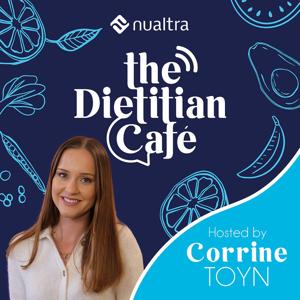
Welcome to The Dietitian Café, a podcast from Nualtra for dietitians, nutritionists, and healthcare professionals, bringing honest conversations and fresh perspectives on important topics shaping…
From clinical practice and public health to the food industry and beyond, each episode blends expert insight with real-world experience.
389 Listeners
570 Listeners

3,595 Listeners

883 Listeners
1,312 Listeners

131 Listeners

1,220 Listeners
238 Listeners
19 Listeners
58 Listeners

2,062 Listeners

775 Listeners

18,920 Listeners

599 Listeners