
Sign up to save your podcasts
Or

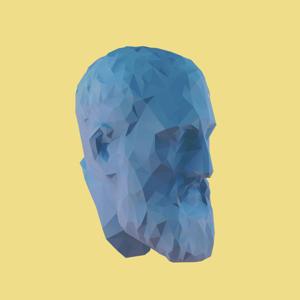


Socrates had a strange idea: that another person can act as a mirror for your own mind, showing you the thoughts you cannot see on your own. In this conversation with philosopher Donald Robertson, we follow that thread through Socrates on wisdom, self-awareness, and the art of asking the right question.
We get into how he used dialogue to surface what people did not know they believed, and what he meant by an eye that can somehow see itself. A short conversation that quietly changes how you listen to other people.
Watch the video version: youtu.be/_vJtpOgMQLo
Free 7-Day Stoic Challenge: stoicchallenge.co
The Stoic Vault: stoicvault.com
The oldest self-help tool might also be the best one, and it fits on a single sheet of paper. I asked Stoic author Donald Robertson to walk me through Socrates' two-column method: a simple way to question your own assumptions, pressure-test a belief, and make a clearer decision.
We trace how this approach fed straight into Epictetus, Seneca and Marcus Aurelius, and why it still holds up as something you can actually pick up and use today. Practical, not abstract.
Free 7-Day Stoic Challenge: stoicchallenge.co
The Stoic Vault: stoicvault.com
When do you speak up, and when do you let it go? When do you push, and when do you step back? Donald Robertson and I get into coping flexibility: the skill of matching your response to the situation instead of running the same move every time.
We pull from Stoicism, CBT and martial arts, including Epictetus on how you work out whether you can actually fight the lion in front of you, and why even Marcus Aurelius trained physically. Underneath it all sits self-knowledge: you cannot pick your battles well until you know your own strength.
Watch the video version: youtu.be/3DX6rTAX-QA
Free 7-Day Stoic Challenge: stoicchallenge.co
The Stoic Vault: stoicvault.com
Modern Stoicism gets sold as self-control and grit, which leaves out the part Marcus Aurelius arguably cared about most. Donald Robertson and I talk about the missing piece: the idea that real strength shows up as kindness, and that anger is closer to weakness than to power.
It is an easy philosophy to misread as cold and detached. We make the case for the opposite, that justice and a kind of brotherly regard for other people sit right at the centre of it. A useful corrective if your picture of Stoicism is all jaw-clenching and no warmth.
Watch the video version: youtu.be/IzmTBMqenG8
Free 7-Day Stoic Challenge: stoicchallenge.co
The Stoic Vault: stoicvault.com
Some people are genuinely hard to deal with: the high-conflict ones, the boundary-trampling ones, the family member you cannot just walk away from. This episode is a practical toolkit for those relationships, pulling from Stoic philosophy and modern psychology.
I get into the caretaking trap (where caring tips over into harming yourself), why empathy can actually lead you astray and compassion serves you better, and how to set boundaries that are about what you do rather than controlling the other person. On the tactical side I cover the "I" model, DEAR MAN, Nonviolent Communication, the Grey Rock technique for genuinely toxic dynamics, and tactical empathy, the labelling and mirroring that quietly de-escalates a tense exchange.
If tense relationships, weak boundaries, or burning out on other people's needs sound familiar, start here.
Books mentioned:
The Compassionate Mind by Paul Gilbert
Against Empathy by Paul Bloom
Stop Caretaking the Narcissist or BPD by Margalis Fjelstad
Never Split the Difference by Chris Voss
Not Nice by Dr. Aziz Gazipura
Free 7-Day Stoic Challenge: stoicchallenge.co
The Stoic Vault: stoicvault.com
I sat down with Donald Robertson, author and psychotherapist, for a proper conversation about Socrates: his life, his methods, and why a man who wrote nothing down still shapes how we think two and a half thousand years later.
Donald blends cognitive behavioural therapy with ancient philosophy, so this is Socrates read through a modern, practical lens: what his way of questioning actually does to your thinking, and how it feeds into the self-help that came long after him. This one ties in with Donald's book How to Think Like Socrates.
Donald's book, How to Think Like Socrates: read.macmillan.com
Audiobook: audible.co.uk
Free 7-Day Stoic Challenge: stoicchallenge.co
The Stoic Vault: stoicvault.com
Part two of the series on building a Stoic daily routine, this time on the hours you actually work. Whether your work is a job, a creative project, or something like training martial arts, the aim is the same: turn it into something you do with intention rather than just grind through.
I walk through a six-point pre-work ritual drawn from John Yates' The Mind Illuminated (motivation, goals, expectations, diligence, distractions, environment), why finding genuine enjoyment in the process makes it sustainable, and the idea of a performance statement to catch yourself when you drift. Then there is treating the work itself as a kind of meditation, a short post-work reflection on what went well, the EAR framework (empathy, assertiveness, respect) for working with other people, and premeditation of adversity in the Marcus Aurelius mould.
Three Pillars of Skilful Communication cheat sheet: stoichandbook.co
Free 7-Day Stoic Challenge: stoicchallenge.co
The Stoic Vault: stoicvault.com
How you start the morning tends to set the temperature for the rest of the day. This is part one of the routine series, focused on a Stoic morning: a sequence of small practices that point you at clarity and resilience before the world gets a vote.
I walk through reading and sitting with a Stoic quote, journaling to build gratitude and anticipate the day's obstacles, a short meditation, reading from the Stoic texts, cold exposure for a bit of deliberate discomfort, and a brief death meditation to sharpen the day. Take the whole thing or borrow the one or two pieces that fit your life.
Timestamps
02:15 Reflecting on a Stoic quote
05:30 Stoic journaling
12:00 Meditation for mindfulness
16:40 Reading Stoic texts
20:30 Cold exposure
24:15 Death meditation
Free 7-Day Stoic Challenge: stoicchallenge.co
The Stoic Vault: stoicvault.com
The next time you catch yourself judging someone, this guided meditation turns that moment around and points it back at you, gently. Drawing on Marcus Aurelius, it walks you through noticing your own version of the fault you just spotted in someone else.
From there it moves toward self-compassion and then outward again, extending a little more empathy to the person you were quick to write off. The aim is not guilt. It is to use the small irritations of the day as material for becoming slightly wiser and kinder.
Free 7-Day Stoic Challenge: stoicchallenge.co
The Stoic Vault: stoicvault.com
A short, practical one on why we put things off and how to stop. I look at where procrastination actually comes from, why the hardest part is almost always the first few minutes of resistance, and how borrowing a professional mindset, showing up whether or not you feel like it, keeps you consistent.
If there is something you have been avoiding, this is a quick nudge and a couple of tools to get moving on it today.
Free 7-Day Stoic Challenge: stoicchallenge.co
The Stoic Vault: stoicvault.com
From the publisher's feed
You've read the books. You know what Marcus Aurelius would do. But when life gets hard, the philosophy disappears. This podcast is for people who want to close the gap between knowing Stoicism and…
Ranked by our users in the last 21 days
828 Listeners

11,791 Listeners

948 Listeners

12,719 Listeners
2,516 Listeners

405 Listeners

4,967 Listeners

579 Listeners

1,341 Listeners

29,197 Listeners
1,377 Listeners
642 Listeners

100 Listeners

27 Listeners

62 Listeners