
Sign up to save your podcasts
Or

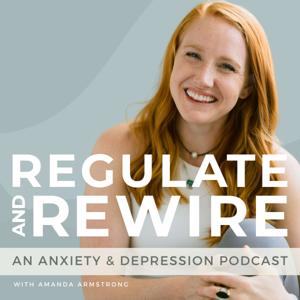
By Amanda Armstrong
Millions of people struggle with anxiety & depression every single day. Regulate & Rewire is where Amanda, a nervous system focused and trauma-informed practitioner, teaches you the lessons
... more

4.9
397397 ratings


The podcast currently has 179 episodes available.
The most played episodes among Podcast App listeners.
In part 3 of our Back to Basics series, we explore why we get stuck in states of dysregulation and why anxiety and depression persist. Learn how modern living patterns and past experiences shape our nervous system responses, and discover a compassionate approach to understanding your symptoms. 3 Takeaways:Your symptoms make sense. Anxiety and depression are often normal responses to overwhelm. Recognize your patterns without pathologizing them.Biology matters. The way you live—your sleep, stress, food, and relationships—can either support or sabotage your nervous system. Start small by changing one supportive habit.Safety is learned. If your body perceives the world as dangerous, even safe moments will feel threatening. Begin identifying your “parts” and their protective roles to shift how you relate to stress.CLICK HERE for the full show notes, resources, and 3 tangible takeaways! — Ps. This is a re-run of this series. It originally aired in February 2025, and is still the series I hear back about the most. Since there’s been a wave of new listeners joining lately, I wanted to bring it back around. And for those of you who were here the first time, I invite you to listen again through the lens of where you are right now, it’s likely shifted over the last year and a half, and just see what lands differently. Looking for more personalized support? 1:1 Coaching (RESTORE): Learn more or book a free discovery call (HSA/FSA eligible & includes comprehensive bloodwork)Regulated Living Membership: A mental health membership and nervous system healing space (sliding scale pricing available). Join here.Order my book: Healing Through the Vagus Nerve*Want me to talk about something specific on the podcast? Let me know HERE. — Website: https://www.regulatedliving.com/podcast Email: [email protected] Instagram: @amandaontherise TikTok: https://www.tiktok.com/@amandaontherise

In part 4 of our Back to Basics series, we explore the "stress bucket" analogy to help you understand why you might be feeling overwhelmed, anxious, or depressed. Learn how to assess your unique stress load and discover personalized pathways to healing. 3 Takeaways:You have a unique stress capacity. When your bucket overflows, symptoms show up. That doesn’t mean you’re failing—it means your body is communicating with you.Identify your stressors. List both baseline and daily stressors. This simple awareness offers a more personalized path forward.Healing is about balance. You don’t have to eliminate all stress. Add support, increase capacity, and shift what you can.CLICK HERE for the full show notes, resources, and 3 tangible takeaways! — Ps. This is a re-run of this series. It originally aired in February 2025, and is still the series I hear back about the most. Since there’s been a wave of new listeners joining lately, I wanted to bring it back around. And for those of you who were here the first time, I invite you to listen again through the lens of where you are right now, it’s likely shifted over the last year and a half, and just see what lands differently. Looking for more personalized support? 1:1 Coaching (RESTORE): Learn more or book a free discovery call (HSA/FSA eligible & includes comprehensive bloodwork)Regulated Living Membership: A mental health membership and nervous system healing space (sliding scale pricing available). Join here.Order my book: Healing Through the Vagus Nerve*Want me to talk about something specific on the podcast? Let me know HERE. — Website: https://www.regulatedliving.com/podcast Email: [email protected] Instagram: @amandaontherise TikTok: https://www.tiktok.com/@amandaontherise
In this first episode of the “Back to Basics” series, Amanda dives into the core of what drives anxiety and depression: your nervous system. When you better understand how this mind-body system works you can work with it towards healing. 3 Takeaways:Your symptoms are protective, not personal. Your nervous system isn’t trying to ruin your life. It’s trying to keep you safe. The more fluently you speak its language, the less you’ll feel at war with yourself.Self-compassion is non-negotiable. Understanding your nervous system can help dissolve self-blame and shift you into a posture of curiosity instead of criticism. That shift alone can change your healing trajectory.You’re likely carrying more than anyone ever taught you to hold. When Amanda describes the nervous system as holding a “bucket” of stressors, it clicks: Most of us are carrying too much with too little support. Of course we’re tired. Of course we’re stuck. The work isn’t to toughen up—it’s to learn how to carry differently.CLICK HERE for the full show notes, resources, and 3 tangible takeaways! — Ps. This is a re-run of this series. It originally aired in February 2025, and is still the series I hear back about the most. Since there’s been a wave of new listeners joining lately, I wanted to bring it back around. And for those of you who were here the first time, I invite you to listen again through the lens of where you are right now, it’s likely shifted over the last year and a half, and just see what lands differently. — Looking for more personalized support? 1:1 Coaching (RESTORE): Learn more or book a free discovery call (HSA/FSA eligible & includes comprehensive bloodwork)Regulated Living Membership: A mental health membership and nervous system healing space (sliding scale pricing available). Join here.Order my book: Healing Through the Vagus Nerve*Want me to talk about something specific on the podcast? Let me know HERE. Website: https://www.regulatedliving.com/podcast Email: [email protected] Instagram: @amandaontherise TikTok: https://www.tiktok.com/@amandaontherise
This morning I wanted to flush my kid down the toilet, it was just one of those mornings. It made me realize that while last week we had a great chat about reactive regulation, it was a bit heavy on the theory vs practical application. I'm extending that conversation today to share some real life examples of how I use these tools in my everyday life, how I used them this morning with my son. So, here's Part 6 of my Back to the Basics Series. 3 Takeaways:Tools work better when they’re practiced in low-stakes moments. Amanda didn’t magically regulate during a meltdown—she had practiced those steps in less charged settings first.You don’t have to fully shift your state to call a tool successful. If it takes the edge off enough to help you stay present, it’s working.Use different tools for different goals. Some tools shift your physiology. Others help you stay with emotion. Both are valid.CLICK HERE for the full show notes, resources, and 3 tangible takeaways! — Ps. This is a re-run of this series. It originally aired in February 2025, and is still the series I hear back about the most. Since there’s been a wave of new listeners joining lately, I wanted to bring it back around. And for those of you who were here the first time, I invite you to listen again through the lens of where you are right now, it’s likely shifted over the last year and a half, and just see what lands differently. Looking for more personalized support? 1:1 Coaching (RESTORE): Learn more or book a free discovery call (HSA/FSA eligible & includes comprehensive bloodwork)Regulated Living Membership: A mental health membership and nervous system healing space (sliding scale pricing available). Join here.Order my book: Healing Through the Vagus Nerve*Want me to talk about something specific on the podcast? Let me know HERE. — Disclaimer: This podcast is for informational and educational purposes only and is not a substitute for professional medical or mental health advice, diagnosis, or treatment. Website: https://www.regulatedliving.com/podcast Email: [email protected] Instagram: @amandaontherise TikTok: https://www.tiktok.com/@amandaontherise
In this second episode of the "Back to Basics" series, we explore the six nervous system states and how understanding them can transform your approach to anxiety and depression healing. 3 Takeaways:Your state determines your story. How you feel physically shapes how you think emotionally. Track your state, not just your thoughts.You experience each state differently. Start noticing your own patterns. When do you feel buzzy and urgent? When do you go flat or withdrawn? That awareness is your first step toward change.Try the paper-on-the-door check-in. Write “What state am I in right now? How do I know?” on a piece of paper. Tape it somewhere visible. Ask it daily. This builds awareness fast—and gently.CLICK HERE for the full show notes, resources, and 3 tangible takeaways! — Ps. This is a re-run of this series. It originally aired in February 2025, and is still the series I hear back about the most. Since there’s been a wave of new listeners joining lately, I wanted to bring it back around. And for those of you who were here the first time, I invite you to listen again through the lens of where you are right now, it’s likely shifted over the last year and a half, and just see what lands differently. — Looking for more personalized support? 1:1 Coaching (RESTORE): Learn more or book a free discovery call (HSA/FSA eligible & includes comprehensive bloodwork)Regulated Living Membership: A mental health membership and nervous system healing space (sliding scale pricing available). Join here.Order my book: Healing Through the Vagus Nerve*Want me to talk about something specific on the podcast? Let me know HERE. Website: https://www.regulatedliving.com/podcast Email: [email protected] Instagram: @amandaontherise TikTok: https://www.tiktok.com/@amandaontherise
The podcast currently has 179 episodes available.
812 Listeners
3,322 Listeners
1,789 Listeners
1,431 Listeners
1,221 Listeners
831 Listeners
12,705 Listeners
2,526 Listeners

5,131 Listeners
583 Listeners
359 Listeners
368 Listeners

343 Listeners
429 Listeners

220 Listeners