
Sign up to save your podcasts
Or



Based on Podcast App listening data
Archana Jayaram stepped in as CEO of Brooklyn Community Services just as one of New York City's oldest nonprofits entered its 160th year. Her first move wasn't a bold new vision. It was a question: "What do you need?"
Founded in 1866, BCS now serves more than 14,000 Brooklynites a year across housing, mental health, education, and workforce development. Archana shares how she's honoring that legacy while listening her way toward what comes next. 🩵
In this Possible in Practice episode, you'll hear:
You'll walk away with a listening-first playbook for leading through legacy, change, and chaos. 🩵
Episode Highlights:
Episode Show Notes: www.weareforgood.com/episode/749
//
Join the We Are For Good Community—completely free.
Join fellow changemakers, share takeaways from this working session, and keep collaborating in a space built for connection, inspiration, and real impact: www.weareforgoodcommunity.com
Say hi 👋
LinkedIn / Instagram / Facebook / YouTube / Twitter
A note before you listen: This episode discusses suicide and suicide prevention. If you or someone you know is struggling, you’re not alone. In the U.S., call or text 988 to reach the Suicide & Crisis Lifeline, available 24/7. Outside the U.S., visit findahelpline.com to find support near you.
Ali Borowsky used to design for the NHL Winter Classic. Now she designs something far more personal: a small blue box that tells whoever finds it that strangers care. 🩵
Rooted in her own lived experience, Find Your Anchor brings color, creativity, and humanity to suicide prevention. Guest co-host Aila Malik brought Ali to the mic to share how a grassroots nonprofit with a product reached 116,000 boxes through handwritten notes, community box builds, and partners from middle schools to the San Francisco 49ers.
In this episode, you'll hear:
You'll walk away with a fresh take on partnership, scale, and the small things that keep people going.
Episode Highlights:
Episode Show Notes: www.weareforgood.com/episode/748
//
Join the We Are For Good Community—completely free.
Join fellow changemakers, share takeaways from this working session, and keep collaborating in a space built for connection, inspiration, and real impact: www.weareforgoodcommunity.com
Say hi 👋
LinkedIn / Instagram / Facebook / YouTube / Twitter
Jeremy Vallerand and a few friends turned a Mount Rainier climb into a fundraiser: $1 for every vertical foot, $14,410 total. It was supposed to be a one-off. It wasn't.
Today, Atlas Free is a global network of 160+ organizations in 67 countries fighting sex trafficking, still fueled by the community hikes and climbs that started it all. 🩵
In this Possible in Practice episode, you'll hear:
You'll walk away with a blueprint for inviting your community into the mission, not just the fundraising. 🩵
Episode Highlights:
Episode Show Notes: www.weareforgood.com/episode/747
//
Join the We Are For Good Community—completely free.
Join fellow changemakers, share takeaways from this working session, and keep collaborating in a space built for connection, inspiration, and real impact: www.weareforgoodcommunity.com
Say hi 👋
LinkedIn / Instagram / Facebook / YouTube / Twitter
1 in 2 American adults is struggling with social connection, and fewer than 20% are thriving. Aaron Hurst, the social entrepreneur behind the Taproot Foundation and the pro bono movement, says that's why volunteering and giving are collapsing, and why nonprofits hold the key to reversing it.
Guest co-host Susan McPherson, author of The Lost Art of Connecting, joins us to dig into the U.S. Chamber of Connection's Six Points of Connection report, the first national index of its kind.
In this episode, you'll hear:
You'll walk away seeing your organization for what it already is: connection infrastructure for your community. 🩵
Episode Highlights:
Episode Show Notes: www.weareforgood.com/episode/746
//
Join the We Are For Good Community—completely free.
Join fellow changemakers, share takeaways from this working session, and keep collaborating in a space built for connection, inspiration, and real impact: www.weareforgoodcommunity.com
Say hi 👋
LinkedIn / Instagram / Facebook / YouTube / Twitter
A pandemic relief territory that grew 39% while every area around it went red. A fund that deployed capital fast and couldn't prove what it did. A 55-year-old nonprofit still running on paper.
Urina Harrell, founder of Vox Pop Branding, walks through all three — what was broken, what she built, and what happened next. 🩵
In this episode, you'll hear:
Three different orgs, one repeatable playbook for connecting data to story to funding. 🩵
Episode Highlights:
Episode Show Notes: www.weareforgood.com/episode/745
//
Join the We Are For Good Community—completely free.
Join fellow changemakers, share takeaways from this working session, and keep collaborating in a space built for connection, inspiration, and real impact: www.weareforgoodcommunity.com
Say hi 👋
LinkedIn / Instagram / Facebook / YouTube / Twitter
Greg Tehven runs a $5.5 million nonprofit with 40 teammates in Fargo, North Dakota — and his advice to leaders is to stop working on problems they can solve alone.
That instinct built Emerging Prairie into the heartbeat of a region's entrepreneurial ecosystem, launched Grand Farm, and turned TEDx Fargo into an event 1,000+ people build their year around. Guest co-host Stacy Huston, CEO of SixDegrees.org, brings Greg on to talk about what it actually takes. 🩵
In this episode, you'll hear:
You'll walk away with a way of building that doesn't require permission, a finished plan, or a bigger budget. 🩵
Episode Highlights:
Episode Show Notes: www.weareforgood.com/episode/744
//
Join the We Are For Good Community—completely free.
Join fellow changemakers, share takeaways from this working session, and keep collaborating in a space built for connection, inspiration, and real impact: www.weareforgoodcommunity.com
Say hi 👋
LinkedIn / Instagram / Facebook / YouTube / Twitter
When ZERO Prostate Cancer's peer-to-peer program started slipping, Victoria Vighetto didn't tell her field staff to make more calls. She walked the constituent journey herself — and found the problem sitting in an email.
The call-to-action button was too far down. The sends were landing at the wrong time for open rates. Registration was where people were falling out. 🩵
In this Possible in Practice episode, you'll hear:
You'll walk away with a repeatable way to audit your own peer-to-peer program — and permission to fix one thing instead of everything. 🩵
Episode Highlights:
Episode Show Notes: www.weareforgood.com/episode/743
//
Join the We Are For Good Community—completely free.
Join fellow changemakers, share takeaways from this working session, and keep collaborating in a space built for connection, inspiration, and real impact: www.weareforgoodcommunity.com
Say hi 👋
LinkedIn / Instagram / Facebook / YouTube / Twitter
An elder told Edgar Villanueva that the medicine that had chosen him was money. One sentence — and it turned an angry, burned-out program officer into the person rewriting how philanthropy thinks about wealth.
Edgar is the founder and CEO of the Decolonizing Wealth Project and the author of Decolonizing Wealth, now in its second edition. His work has helped move nearly $1 billion toward the communities that need it most. 🩵
Joining us as guest co-host is Lindsey Fuller, Executive Director of The Teaching Well.
In this episode, you'll hear:
You'll walk away with a different starting point for every funder conversation you have. 🩵
Episode Highlights:
Episode Show Notes: www.weareforgood.com/episode/742
//
Join the We Are For Good Community—completely free.
Join fellow changemakers, share takeaways from this working session, and keep collaborating in a space built for connection, inspiration, and real impact: www.weareforgoodcommunity.com
Say hi 👋
LinkedIn / Instagram / Facebook / YouTube / Twitter
Connie Lewin found the funders. She wrote the emails. She sent the proposals. The response was silence.
With a $1 million goal for a small nonprofit in Rwanda and no established high-net-worth donor network, Connie had to quickly step into a leadership role and take responsibility for the organization’s goal to scale its impact and operations in three years.
What finally moved the money wasn't better writing. It was closing the distance between donors and the people at the center of the mission by tapping into donors' heads and hearts and making the case for giving by connecting business strategy with empathy. 🩵
In this Possible in Practice episode, you'll hear:
You'll walk away with one question to run before your next appeal: do we have a fundraising problem, or a distance problem? 🩵
Episode Highlights:
Episode Show Notes: www.weareforgood.com/episode/741
//
Join the We Are For Good Community—completely free.
Join fellow changemakers, share takeaways from this working session, and keep collaborating in a space built for connection, inspiration, and real impact: www.weareforgoodcommunity.com
Say hi 👋
LinkedIn / Instagram / Facebook / YouTube / Twitter
Jai Al-Attas started a record label at 16, sold it to Virgin Records at 24, and never went to college. So when he moved to LA and tried to get people from a reentry program and a homeless youth org into music industry internships, the question that kept coming back — "are these people in college?" — landed personally.
He didn't have a plan. He had a chip on his shoulder and $1,800 he needed for rent. He spent it on 10 Chromebooks instead. 🩵
Today Creative Futures Collective has moved 3,500 creatives through its programs in 10 cities across three countries — into Nike, Live Nation, Interscope, Forbes 30 Under 30, and one Ralph Lauren artist residency.
In this episode, you'll hear:
You'll walk away with permission to start the thing you've been waiting to be ready for. 🩵
Episode Highlights:
Episode Show Notes: www.weareforgood.com/episode/740
//
Join the We Are For Good Community—completely free.
Join fellow changemakers, share takeaways from this working session, and keep collaborating in a space built for connection, inspiration, and real impact: www.weareforgoodcommunity.com
Say hi 👋
LinkedIn / Instagram / Facebook / YouTube / Twitter
From the publisher's feed
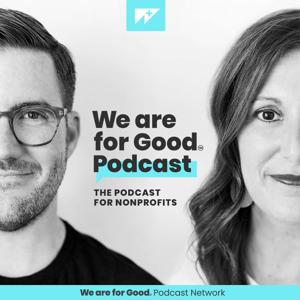
The We Are For Good Podcast brings nonprofit professionals + everyday changemakers into conversations with the most innovative, heartwired leaders in social impact. Hosted by Jon McCoy +…
Join our value-aligned community—it’s free—at weareforgoodcommunity.com.
About We Are For Good
We Are For Good is a storytelling, learning + activating community built for nonprofit professionals + everyday changemakers. Through our podcasts + media, purpose-driven activations + global gatherings, we equip for-good leaders with the connection, skills + inspiration to grow their impact. Because we believe community is everything—and together, we can create an Impact Uprising.
Learn more at weareforgood.com.
Ranked by our users in the last 21 days

37,988 Listeners

43,314 Listeners
4,913 Listeners
325 Listeners
12,710 Listeners
6,688 Listeners
5,455 Listeners
5,105 Listeners
9,062 Listeners
1,014 Listeners
3,334 Listeners
4,511 Listeners
41,371 Listeners
10,515 Listeners
377 Listeners
2 Listeners
13 Listeners