
Sign up to save your podcasts
Or

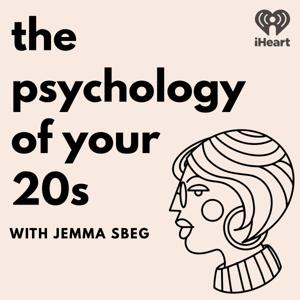
By iHeartPodcasts
A podcast that explains how everything is psychology. Even your 20s. Hosted by Jemma Sbeg, each Tuesday and Friday we deep dive into the science and psychology behind a topic, concept or universal
... more

4.8
13751,375 ratings


The podcast currently has 474 episodes available.
The most played episodes among Podcast App listeners.
The fear of missing out or not seizing every moment are some of the biggest worries we experience in our 20s. However, spending time alone isn’t the same as being lonely or doing nothing - in fact, it’s quite the opposite. In this episode, we explore why we resist being alone - but why learning to do so is psychologically positive, and can even be a superpower. Watch on Netflix: HERE • Why we culturally and socially villainise solitude • How constantly being online interrupts our ability to be truly alone • The creative and emotional benefits of spending time alone • Why our capacity to be alone is a reflection of our overall maturity • How we can embrace the power of solitude Follow Jemma on Instagram: @jemmasbeg Follow the podcast on Instagram: @thatpsychologypodcast Subscribe on Substack: @thepsychologyofyour20s For business: [email protected] Our favourite sources: https://spsp.org/news-center/character-context-blog/social-costs-seeking-solitude https://www.ted.com/talks/susan_cain_the_power_of_introverts?language=en https://www.theguardian.com/lifeandstyle/2025/feb/02/quiet-please-the-remarkable-power-of-silence-for-our-bodies-and-our-minds The Psychology of your 20s is not a substitute for professional mental health help. If you are struggling, distressed or require personalised advice, please reach out to your doctor or a licensed psychologist. See omnystudio.com/listener for privacy information.

What is the shadow self? And how do we meet ours? In today's episode we explore what it means to get curious about the shadow parts of ourselves. We take a grounded look at shadow work - where the idea came from, the layers of our psyche, and how the repressed parts of ourselves show up. We explore: • What Jung meant by the shadow and the persona • How the dark or disowned parts of ourselves can develop • Why anger, neediness, ambition, or confidence can feel uncomfortable to acknowledge • The role of projection, triggers and repeated patterns • How to approach shadow work cautiously and with curiosity Watch on Netflix: HERE Follow Jemma on Instagram: @jemmasbeg Follow the podcast on Instagram: @thatpsychologypodcast Subscribe on Substack: @thepsychologyofyour20s For business: [email protected] Our favourite sources: The book I spoke about: HERE The YouTube video: HERE The Psychology of your 20s is not a substitute for professional mental health help. If you are struggling, distressed or require personalised advice, please reach out to your doctor or a licensed psychologist. See omnystudio.com/listener for privacy information.
You know when someone seems to breeze through life, can approach any social situation and challenge with such self-assured confidence? It seems innate - something they were born with. But what if that's not true? What if, instead of a fixed personal trait, confidence is actually a set of learnable abilities, a dynamic skill that anyone can cultivate, sharpen, and ultimately master? Today, we’re challenging the notion that confidence is a trait, and instead something you build. Things we discuss: Why confidence is dynamic and adaptable Self-efficacy as a driver of confidence How "growth mindsets" can revolutionise your approach to challenges and setbacks Understanding the locus of control to fuel or hinder your forward momentum Actionable strategies to build your confidence from the ground up If you’ve ever thought, “if only I was just born confident”, this episode is for you. Watch on Netflix: HERE Follow Jemma on Instagram: @jemmasbeg Follow the podcast on Instagram: @thatpsychologypodcast Subscribe on Substack: @thepsychologyofyour20s For business: [email protected] The Psychology of your 20s is not a substitute for professional mental health help. If you are struggling, distressed or require personalised advice, please reach out to your doctor or a licensed psychologist. See omnystudio.com/listener for privacy information.
The Oedipus complex is one of Freud’s most renowned and shocking ideas. In this episode, we dive into the origins of the theory and whether anything really remains once its gendered assumptions and controversial sexual claims are stripped away. We explore: - How the Greek tragedy of Oedipus inspired Freud’s theory - What Freud meant by unconscious childhood desire and parental rivalry - The importance of the phallic stage - How Freud believed it was resolved - and what fixation was thought to mean for adulthood - His problematic gendered ideas - The scientific and ethical problems surrounding the theory - How modern psychoanalysis has reinterpreted Oedipal ideas Watch on Netflix: HERE Follow Jemma on Instagram: @jemmasbeg Follow the podcast on Instagram: @thatpsychologypodcast Subscribe on Substack: @thepsychologyofyour20s For business: [email protected] Our favourite sources: https://lacanianworksexchange.net/wp-content/uploads/2023/05/19260101-The-Flight-from-Womanhood-The-Masculinity-Complex-in-Women-as-Viewed-by-Men-and-by-Women-Karen-Horney-IJP-7-p324-339.pdf https://www.tandfonline.com/doi/abs/10.1002/j.2167-4086.2004.tb00151.x https://psycnet.apa.org/doiLanding?doi=10.1037%2F0033-3204.32.4.535 https://www.routledge.com/The-Oedipus-Complex-A-Contemporary-Introduction/Rohleder/p/book/9781032495651 The Psychology of your 20s is not a substitute for professional mental health help. If you are struggling, distressed or require personalised advice, please reach out to your doctor or a licensed psychologist. See omnystudio.com/listener for privacy information.
It’s a known fact that time moves faster as we get older, but what does this really mean, and can we slow it down? In this episode, we’re going to try to make sense of why flies as we enter our 20s - from memory, to novelty, eye movements and the effects of COVID. Watch on Netflix: HERE We explore: Different types of time: measured vs. perceived What makes time feel fast and slow? The effect of the pandemic The relationship between time and age How social media is making time go faster The 4 ways we can feel like we have more time Happy listening! Follow Jemma on Instagram: @jemmasbeg Follow the podcast on Instagram: @thatpsychologypodcast Subscribe on Substack: @thepsychologyofyour20s For business: [email protected] The Psychology of your 20s is not a substitute for professional mental health help. If you are struggling, distressed or require personalised advice, please reach out to your doctor or a licensed psychologist. See omnystudio.com/listener for privacy information.
The podcast currently has 474 episodes available.

4,678 Listeners
362 Listeners

245 Listeners

62,414 Listeners

10 Listeners

207 Listeners

8 Listeners

351 Listeners

64 Listeners

249 Listeners

143 Listeners

237 Listeners

1,549 Listeners

470 Listeners
1,400 Listeners

839 Listeners

595 Listeners

1,406 Listeners

63 Listeners

3,911 Listeners

277 Listeners

159 Listeners

1,034 Listeners

504 Listeners

1,928 Listeners

623 Listeners

2,427 Listeners

457 Listeners

18 Listeners

189 Listeners

25 Listeners

357 Listeners

59 Listeners

34 Listeners

28 Listeners